Showing posts with label Balkans. Show all posts

Tuesday, May 15, 2012

More Cricket in Belgrade

The view from fine leg
After keeping this blog for more than a year now, it seems this is the point in the blogger's life were we realize that our lives are essentially cycles within cycles and all we can do is keep on dressing up the mutton as lamb and pray no one catches on. But at least we have the now annual Belgrade trip to throw a little fun into the banality of existence.

The Serbian guys (and a few gals) we first met last Spring came up to Budapest to play a couple times last summer, so by now they seem like old friends rather than new friends already, even if I misplaced a few names I should have remembered. Belgrade still has a sense of unselfconscious fun - at least the parts we see - that in Budapest seems to have gotten in large measure drowned in Hungarian cynicism and insularity and post-communist consumerism. And you can still smoke in the bars there. Not that I smoke anymore. Much. I don't usually eat big chunks of red meat either, but hey, this is Serbia.


Here we have from left to right, Tim, who only revealed himself to us that morning, as we bought our train tickets, as being back from a six month visit to Oz, and then immediately realized he had forgotten his Oz passport at Adrian's hostel and had to do a taxi-borne Chinese fire drill with just minutes to spare for the train. Adrian, looking regally simian, the only leftover from last year's trip besides me. Slightly touched Stokie Kevin - the less said the better. And Dávid, smugly thinking, "I might have lost my train ticket 90 seconds after purchasing it and had to buy a new one, but at least I'm not the goat who forgot his passport." Not shown are Gareth, Kevin's long-suffering son-in-law and, for obvious reasons, Hungarian slow-bowling wunderkind Disappearing Dani who mesmerizes opposing batters out of a pre-determined number of wickets and then vanishes from the corporeal world until the next match. So, not counting second passports and Dávid's various fantasy nationalities, it's two Brits, two Aussies (a third, Andrew was already in Belgrade for his business recruiting the people of the Balkans to settle the Outback), two Hungarians and me. Typical DCC diversity, but with some typical DCC last-minute party pooping, not enough for a team, for which we'll borrow a few Serbs. Morale is high in the photo because the Hungarian border guards have just let me and Kev run across to the pub to replenish our dangerously low beer supplies before doing the passport check.  

And a long trip it is as we go into single .... click..... track.... click.... mode..... click..... between Subotica and Novi Sad as we got to enjoy the unblurred beauty of every cornstalk in the Vojvodina, the same way God sees them when he's not in a rush to get anywhere. And then we get to Belgrade and find the queen of all hostels, furnished with oversize kitsch tables and chairs made from old egg cartons, shopping carts and bathtubs and with one wall full of illuminated mildly homo-provocative paper illustrations and a balcony and a bar downstairs. Just the thing for a cricket team free from the womenfolk for a few days.

Tim and Adrian show their affection for gay Balkan kitsch
For supper we had our first round of pljeskavicas for the weekend on cobble-stoned Skadarlija street, where Kevin found a back-up band to replace the one that got his single played by John Peel in 1983.

When the old cricketer leaves the crease
Sadly no audio/video exists of this startlit serenade. And then the night dissolved into a quick tour of Kalemegdan Fortress, which first-time Belgrade visitors Gareth and Dávid pretty much ignored in favor of attempting the hopeless task (for Europeans - even Canadians get hopelessly muddled) of teasing out the metaphysical themes of the Dukes of Hazzard. Tim has a funny story: he's been to Belgrade before but his visit was restricted to a transfer on the train up from Istanbul to Budapest with a bad hangover - just like the Orient Express but with no food or water and about 36 hours longer - and scouring the streets for something to eat. Who knew the best pizza in the whole world was to be found in a Belgrade side street?


The next day it turns out we have to play cricket. With help from Luka and Nenad at right we put in a respectful showing against a mostly mixed Belgrade XI. Partnered with Luka I manage to stay in for 3 overs, which isn't so bad for me, but then I'm fooled by a tricky spinner for an LBW. Dani, putting in a brief social appearance at left from the astral bowlers plane was really man - er, entity - of the match with 3 wickets taken, just as foreseen by the oracle.


Then more pljeskavicas at the very same place on Skadarija, with the whole of Salix CC, the London-area team we'd be playing the next day joining us. Here we have smart-mouthed Andy flanked by Serbs Haris and Vlad, the main organizers of Cricket Serbia and two of the nicest guys you will ever meet. Andy and I have a bonding moment when buying smokes we get separated from our unit on the way to a Serbian wedding party on the Sava side of town (I don't think large groups of strangers (to the bride at least) get impromptu invitations to wedding parties in other countries, even if it's not the official formal dress-up party) but I get us there in a route that was about 200m longer than optimal, which wasn't good enough for Andy, who is former royal artillery and knows maps backwards and forwards. So why didn't he find the place for us instead of griping? Because Her Majesty didn't teach you Cyrillic, did she Andy?

Somehow we make it back to the hostel in the appropriate numbers and the next day it is more cricket, another loss, in which I didn't get a bat, this time against eventual champions Salix. The Serbs are very proud of their new grounds on part of a major sports complex that was slated to be a water park, but the Italian developer ran out of financing, so they got it on the cheap. A little bit of grading and a refreshment kiosk and it will be prime cricket territory. We'll be back next year to see.

Mladen, the taxi driver who has been ferrying us between city and grounds suggests a Serbian folk tune we may like:


On the night train home, herded into a common carriage without compartments, we're the group of loud guys that you hate sitting next to on the train as Kevin expounds on his severe distaste for puppies, God, anyone from the South of England and for all members of the various socioeconomic classes oppressing the pottery workers of Stoke - he actually has an MBA from a respected (the kind where you actually go there and study stuff) university in the US, which I try to point out automatically makes him an upper-middle class American even if he never earns another penny in his life, but he wasn't having it. But somewhere around the border, after conversation has lulled around less heated topics like the state sport and motto of the State of Maryland (jousting and Fatti Maschii Parole Femine, and it wasn't me who brought it up) it's sleepy time and dreamy resolutions of our return next year and at least, say, three days, without beer or red meat. Goodbye Belgrade, we'll see you again.


Tuesday, September 13, 2011

Dalmatian Holiday

Not one but two trips south of the border to Yugoslavia this year! (Yes, I know Yugoslavia doesn’t exist any longer, but please humor me) In this case it is the Dalmatian coast, to bake in the sun and eat nothing but grilled squid and cevapcici, and maybe a little bit of prsut (Dalmatian prosciutto minus the vowels) on my toast for breakfast.

Bosnian grill. Who told them beer should be sweet?
Móni and I had been to Croatia on numerous occasions, all up and down the Dalmatian coast. It’s our closest stretch of seashore, so is a kind of a default beach holiday for Hungarians who need a salt-water fix they can’t find on Lake Balaton. Lots of interesting stuff to see, although we wouldn’t be covering much of any new ground on this trip. Basically, the further south you go on the coast, the more dramatic the scenery, and the less crowded the beaches, so for this trip we had picked out a spot on the Peljesac peninsula between Split and Dubrovnik, a long mountainous knob sticking out of the sea, yearning to be an island but not quite succeeding, and studded with little fishing villages and vineyards – we were in the tiny village of Postup, the second most famous wine producing area in all of Croatia.

Cove at Postup

Folti the otter. Taken from Korcula. Orebic and Postup in background.


This was a sort of mix-and-match family holiday for us (with Móni’s sister Andi and her partner Péter, and Péter’s parents, and my Mother and husband Gil, who fly to Europe regularly to visit her family and fit in a trip with us to some part of Europe they hadn’t seen before. And, of course, Folti, who temporarily mutates into an otter whenever we visit the seacoast, or any body of water short of a puddle, in which she mutates into a miniature furry hippopotamus) renting an apartment for a week and taking daytrips some of the time and enjoying the sun and sea for the rest, which the proper way to enjoy a Mediterranean holiday. Wherever you go, there is always something interesting to see nearby.

I can tell you it took a lot of work to find some kind of combination of 4 bedrooms, four bathrooms in a beach residence that takes dogs and that everyone could agree on. Nothing fancy, and a bit far from both civilization and the beach, but with a marvelous view of Korcula and the Adriatic.

We reach it after a two-day drive—having stopped over in Trogir in middle Dalmatia, a lovely little town close to Split, where we picked up Mom and Gil, who had flown down from Budapest. Trogir was where we stayed for the week on our first visit to Croatia, and I recommend it for a quick airborne visit from points north and west, since Split airport is right next door, especially if you are a plane spotting aficionado.

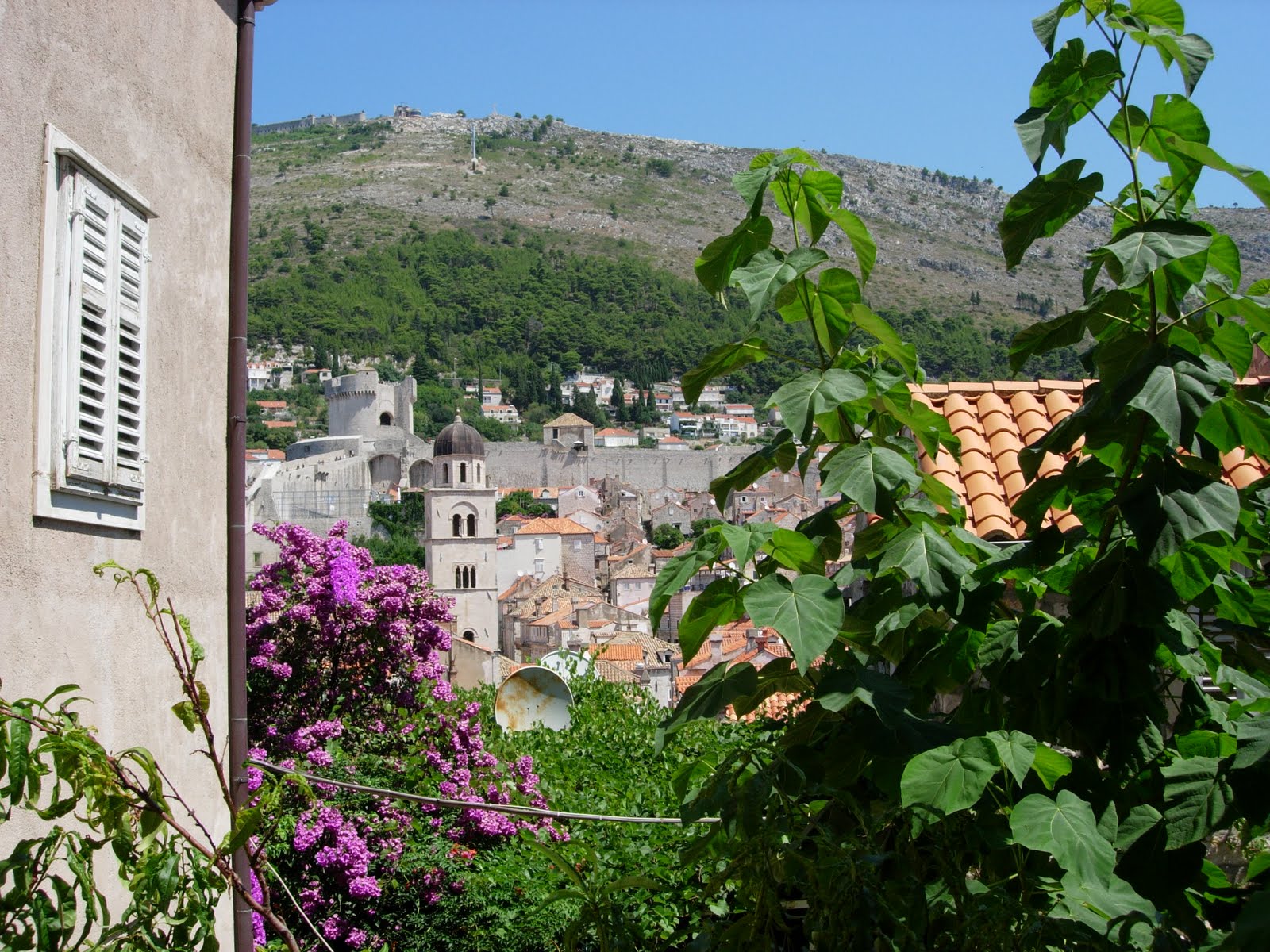
After finding our apartment and resting our drivers for the first day, we took our first excursion to Dubrovnik on the second day: a well-preserved little gem of a former city state that flourished on maritime trade for several centuries by outwitting its much stronger enemies, like the Turks and Venetians, until Napoleon came around and ended the party. It took a beating in the Yugoslav wars but was already restored by my first visit, in 2002 or so. Now there are loads and loads of tourists, and of course, mediocre overpriced cooking to feed them.


Main square of Dubrovnik

Labarynthine alleyways

But walk out the old city gate and you're at the beach

No cars. My kind of town.

Fascinating interplay of light and shadow


Second day trip is to Korcula town and a tour around lovely Korcula island, across the sound by Ferry from Postup. This was once a fairly important port, as far back as medieval times, and claims Marco Polo as one of its sons. These cities on the coast have always been closely linked to Italy, and particularly to Venice, although not on an entirely friendly basis, and one enters into the debate about whether he was a Dalmatia Italian or a Dalmatian Croat, or even a Dalmatian at all, at one’s own peril. Great grilled fish in the little fishing villages outside of Korcula town itself.

Gazing out yonder from the tower of what might be the Marco Polo family house, depending on whom you ask
The third day trip is to Mostar, in Bosnia. Well, technically, Herzegovina. The Stari Most, now the Novi Stari Most, since after surviving 500 years of Balkan history, the Croat artillery saw fit to shell the original, along with the rest of the downtown area, for no good strategic reason except to remove physical cultural evidence of the Islamic presence in the region. There’s a new Muslim cemetery next to one of the downtown mosques where every single headstone I saw, for infants, children, adults, and geriatrics, all bore 1993 as the year of death.

Just like the cover of my copy of Black Lamb and Grey Falcon

Exotic stuff for a fair price, probably made in China

Nice restored houses and shovelled house

Looking up the Neretva from the bridge

Folti leading Andi and Peter up the bridge

For a few Euros you can watch these guys risk death. Or even better, wait for someone else to pay and watch for free.

Where'd he go?


Mom and Gil in front of Mosque


Mosque interior. Work of Mimar Sinan - creator of the Istanbul cityscape

Turkish-style house

Shell damage. expensive cars. dramatic setting.


But the city seems to be recovering nicely now, at least from an outsider's point of view. Mostar still looked pretty much like a war zone at our last visit in 2005, which formed an interesting counterpart to the flowering banks of the Neretva and the rebuilt bridge rising above them. Today, almost all of the major buildings in the bustling downtown area seem to be rebuilt, although a lot of the walls still show shell/bullet damage – which we still have in Budapest too in many spots, left over from WWII and 1956.


You don’t usually get too much colorful interaction with the locals on these beach holidays in high season, especially with a big family group, but there was a funny one here with a jovial Bosnian border guard who, spying the “H” on Peter’s license plate, initiated a conversation with Peter which consisted entirely of their reciting the names of Hungarian and Serbian water polo players, pointing and laughing. And then: “London!” “London! Da! Da! Ahahahhaa!” Point. Waggle finger. "Ahahahahha"

The less jovial Bosnian police are notoriously concerned about making sure tourists do not risk and limb by taking the unfamiliar roadways at the same speeds that the locals do, or even giving the appearance, to them, of doing so, despite what your odometers say. Peter’s father, driving the other car met them this time, although we knew from experience to crawl along and enjoy the (very striking) scenery along the Netetva. Fortunately, fines can be negotiated to meet any budget, as long as you don’t expect a written record. Don’t get angry; just think of it as a tourist tax.

The rest of the week was given over to resting on the beach, but not for Arthur. In 2005 when we were here in the area, I swore that one day I would conquer Sveti Ilija (Saint Elijah), the 961m peak looming atop the peninsula, and now the hour of our reckoning had struck.

Szent Ilija from Korcula

After some initial interest from among my various co-travelers collapsed, it was by myself that I set out from the Franciscan monastery in Orebic. Excelsior! It’s not really a good idea to climb such mountains solo, particularly in the light drizzle that was falling, so I hung around to make sure others were also making the climb, and partially glommed on to a couple Poles with whom I could compare notes in pidgin German as to where the cross marking our final destination might stand: “Hier giebts es kein Kreuz!”, “Vielleicht da drüben!”, “ja! noch ein bisschen”.

Italy, the Gulf of Lyons, and North Africa


Hier haben wir ein Kreuz.

Made it in 2 hours and 45 minutes. From the peak you get a great view of most of Europe and parts of northern Africa, and Asia Minor. Back down in about 2, which exactly corresponded to the lifespan of the Chinese children’s knockoff Juventus FC knapsack I had picked up in Mostar the previous day for 5 euro for the purpose of slogging my water bottles up this hill.

On the final day, able to hobble no further than the distance between the kitchen and the backyard grill (the old fashioned kind with a chimney) I appointed myself grillmaster and fired up a bunch of squid and cevapcici – exactly what we had been eating all week for three times the price at restaurants all over the area.

Croatians make the best grilled calamari. Everyone else wants to bread it like some kind of crazy onion ring, which completely kills the flavor, you might as well just eat onions, but the Croats know that it should be grilled whole until only slightly chewy (a tip—tentacles don’t grill well. You can throw the tentacles in a tomato sauce for pasta instead). The squid were all frozen imported from South America, so I don’t know why we can’t do this in Hungary. One gets conflicting information about how much fish and squid is actually left in the Adriatic these days. Based on my look at fish markets and supermarkets both here and on the Italian side last year, I would guess not so much as one would like.

In many ways, for me, Croatian is the ultimate national cuisine because due its odd shape and history, half of the country is really, historically and climate-wise, part of Central Europe and they eat stuff that is similar to the tastier things that Hungarians eat, whereas on the coast the Italian influence provides them with excellent pastas and risottos, including seafood for as long as stocks hold out, and the Balkan influence means they have excellent seasoned grilled meats and burek and whatnot. So if some hypothetical culinary bully came along with a baseball bat and informed me I could only eat food from one country for the rest of my life, but could pick which one, I might pick Croatian as kind of a cop out.

The local red wine turns out very well too, even though I didn’t taste too much as it was August with heavy-duty walking involved, so I was more interested in the juice of the barley when it came time to rehydrate, but we did try some from the local vintners and they do in fact make some stalwart southern reds out of this plavi mali “little blue” grape of theirs, some a bit raisin-y. Whites were a bit less interesting, but I don’t usually go bananas over Mediterranean whites anyway, except for sherries.

Our week is up. Time to clear out. On the way back we have to deposit Mom and Gil at Split for their flight home, so assuming traffic holds out this will be the day to show them Diocletian’s palace. The traffic does hold out! Generally, apartments in Croatia change over on Saturdays, which means that everybody wants in and out at the same time and on past trips we have had to contend with epic traffic jams, but now that the new highway is in place (and it really is a splendid highway if pricy at the tollgate, with lots tunnels through the Dinaric Alps that look like they were put there by serious Teutonic engineering company) almost the entire way down to Dubrovnik, there were really no problems.

So we had an hour and a half to join the throngs in a quick tour of Split. One thing about a declining birth rate in Europe is at least in a few decades those of us who remain will be able to enjoy our cultural patrimony in peace. In truth though, places like Split and Dubrovnik should be seen at least once in life, so we can’t begrudge our fellow tourists for showing up, only for their idiotic comments. They should read the book first so they know what they are looking at instead of standing in the way gawking. One of these days I would like to visit the Adriatic in the off-season. November or March. Probably not Split though. Trieste and the Slovene coast is next on my list. Border regions! Love them! Also need to make it to Sarajevo sometime.

My copy of “Black Lamb and Grey Falcon” isn’t going to survive too many more trips to the Balkan so I picked up an overpriced copy of Misha Glenny’s “Fall of Yugoslavia” at one of the Split bookstores to see if it changes my mind on anything. So far not: still feel that the Serbs were unfairly singled out, maligned, and air-struck in a complicated situation full of devious politicians where there was plenty of blame to go around.

Lots of waterfalls

Last stop – on the way home we slept overnight in bungalows at a campsite near Plitvice National Park (finally a place I hadn’t already seen once or twice!). This is a beautiful assortment of lakes at different levels connected by a somewhat otherworldly network of waterfalls. We only had a few hours to walk around on the platforms they had though, so this area will merit a future visit for a few days of hiking someday, if the bears don’t eat us.

Saturday, April 30, 2011

Cricket in Belgrade

Few people know that I am a highly respected international athlete. Perhaps not so respected for my athletic ability, but I am respected for working out how to get the rest of the cricket team from one nation to another, keep them from getting lost, acclimatizing them to local customs and history, etc.

Easter weekend a few of us – Steve, Adrian, Shobhit, and myself – from the Dunabogdány Cricket Club headed down to Belgrade to play in a Twenty20 (an abbreviated version of the game that I like, because it's shorter) tournament being held by our cricket-mad Serbian neighbors.

Serbia being on an Orthodox calendar, Easter is usually celebrated on a different weekend than it is in Hungary. This weekend, however, the holiday happened to coincide in both countries and so Monday would be a day off. This “Easter Monday” concept rather surprised me when I first moved to Europe, but then I crunched the numbers and realized that, yes indeed, if you sit in a tomb for three days after being crucified on a Friday, then it is indeed on a Monday that you rise from the dead, not Sunday. The US government must have hastened the Resurrection in the name of national productivity.

This was my second visit to Belgrade, having gone there for a few days with Moni last year. It’s really one of my favorite cities with a great party vibe. Of course, it was a bit sedate this holiday weekend, by Belgrade standards, but at least the air was better from the reduced traffic.

So, after a long train ride down – it’s less than 400 km, but the train runs as a local on both sides of the border, so it takes a while to get there – and paying the extortionate taxi charge from the Belgrade train station – just like in Jordan, these guys know they have you over a barrel – we found our hostel on one of the center’s historical streets.

I had never been in one of these backpacker’s hostels where you stay in a dorm room with other strangers, and felt a bit too old for it at first. We thought we might have the room to ourselves, but the remaining three beds were occupied – with friendly, er, young people from various countries. Anyway, the whole experience was tolerable enough but I think I prefer meeting people when they are awake. Probably a lot of fun if you are in your 20s and backpacking around, and very cheap. This was my first trip in a number of years that came in under budget.


The other guys not having been to Belgrade before and my being team Yugoslavia expert, I took them to look at the downtown and Kalemegdan Fortress, and they paid such careful attention to my history lesson that I bought them a beer afterwards. This is the dramatic centerpiece of the city, perched up on a hill at the confluence of the Sava and Danube, and made a favorable impression on my companions. Actually, we had originally thought that we would be playing in the sports fields underneath its ramparts, as this is what the Serbian cricket website said. But later it emerged that they had stopped playing there, because it was a crowded park and there was too much danger of plunking a kid or a dog with a cricket ball. Instead we would be playing on a soccer field in a large park on the outskirts of the city.

I found an old restaurant from my last visit that could accommodate Steve and my craving for cevapcici and pleszkavica, Adrian’s sudden craving for a wiener schnitzel which probably hit him the moment we crossed out of the former Habsburg Empire, and Shobhit’s constant craving for rabbit food. Then our Serb hosts showed up. These guys would proceed to take wonderful care of us over the weekend, showering us with legendary Serbian hospitality. We spent the latter part of the evening in one of their local pub before retiring to our bunks at a not-too-unreasonable hour.

The next morning, after a bit more wandering around Belgrade, it was off to our match. Steve had already left to umpire the first match. The tournament consisted of four teams. Two Serbian sides, a team that flew in all the way from Scotland, and although we had been joined by two other players from Hungary, we were still only half a team and would play together with another half-team from Slovenia. Steve thought we should call it the "Sluggery", which I thought was clever, even if no one else did.

The Scots had lost to one of the Serbian teams in the morning, and we then proceeded to take on the other Serbian team and get beaten quite badly. They plowed through the heart of our order fairly quickly, which meant that I got a bat, but as usual, I had to face the other team’s fastest bowler against whom I am invariably helpless and got out after a couple balls. The next day we would be playing the Scots for the wooden spoon and the two Serbs teams would duke it out afterwards for the championship.

But we regrouped at the evening social held at an Irish pub in the part of town where I had stayed on my last visit and got to know our Slovenian teammates a bit better. Also one of the Serb history students answered some questions I had been dying to know for years about the assassination of King Alexander Obrenovitch and Queen Draga. (Their bodies were thrown out of the window on the park side, not the street side, but it wasn’t the Old Palace that is there now. It was an Older Palace that had been demolished to make way for the Old Palace.)

Now that we were a properly lubricated organization, we thought we had a good chance with the Scots. Whereas both Serbian teams seemed to be made up of students, both locals and ex-pats, in the flower of youth, the average age and general physical fitness of the Scottish team was probably closer to our own. I didn’t do much in this match, batting too low in the order to get a bat and not having anyone hit anything my way in the field, so spent most of the time daydreaming. Shobhit was really the star of the show, if not a slightly overzealous one, with excellent batting, bowling, a beautiful one-handed catch up in the air right off the bat. Below we have Scots and Sluggery posing together after the match in the spirit of the brotherhood of cricket.


For lunch our new Serb friends served up an entire roast pig, fresh from the butcher and carved up in several boxes of delicious crispy succulent goodness.


 A noble end: the beast can rest proudly. Some of the Serbs had been avoiding meat for several days before Easter, and now busily began making up for it. The Serbs are great meat lovers, even more than the Hungarians or other carnivorous neighbors in the region. Also, they take their Easter eggs seriously. We were offered these nicely painted eggs several times over the course of the day, once after buying a couple rolls at a bakery. One egg would pretty much decimate the profit margin on that, I think.

After lunch we settled down to watch the all-Serbia championship, cheering for the team that didn’t beat us the previous day. They got beat though, in an unusually low-scoring match. A family of English tourists or ex-pats out for an excursion wandered by during the match, asking whether they had stumbled on a mirage.

At the end, the Slovenians had to head home and many of the Serbs had family obligations to run home to for Easter, but the rest of us sat down for refreshments at a nearby café.


I was seated in a cluster of friendly Scots from Edinburgh, at the camera end of the table. At first I found it a bit difficult to understand them but with the help of the magic potion you see on the table, I could speak Scottish too. Since conversation seemed to revolve around sports, I got up the nerve to ask a question I had asked English sports fan before, but never a Scot: If countries like Belgium and Spain, which consider themselves to be composed of separate “nations” can field a single team for international soccer, wouldn’t the entire UK maximize its chances at success by abandoning the home nations approach and instead get all of its best players all on one team?

“Ooh Noo,” they answered, shaking their heads slowly, “That wouldn’t do at all. If we did that, then our best player would be fetching the water, the one from the Northern or Ireland would be giving the massages. It would be the end of Scottish football.”

So, basically, colonial resentment has hardened too much for attitudes to change anytime soon. Come to think of it, I wouldn’t want the English national football side playing for me either.

Goodbyes all around, it was back to the railroad station for the overnight train back home, where Adrian learned that Hungarian border guards do not accept crumpled tourist maps of Belgrade as identification valid for international travel and Steve showed all of us how to sleep with a half-full beer bottle in your hand without letting it fall. We, for our part, look forward to hosting everyone in Budapest soon.