Tuesday, July 26, 2011

Budapest Walks: Buda Hills and the Elizabeth Lookout

Last weekend we had a brief interval of beautiful weather between the pulverizing heat of the previous week and the cold and rain of this week. Nice weather for a good hike.

Destination: the top of the Jánoshegy ("Mount John". I don't know which John it's named after. You are free to use your imagination, especially since Budapest now has an Elvis Presley Square) in the Buda Hills, at 538 meters the highest point in Budapest, about a 400 meter climb from the Danube. Of course, we've wandered up around there many times, but never hiked up from the base, much less all the way from home. But we will be on holiday in Croatia shortly, and there is a certain mountain there that I plan to climb. So we need a bit of training.

We saddle up Folti and off we go. First crossing Erszébetváros - Elizabeth-town - our own District VII, which will get its own blog entry at some point. There is an Elizabeth theme running in this one though. They are all the same Elizabeth, nicknamed Sisi, Empress of Austria, Queen of Hungary, wife of Franz Josef (why is usually only half his name anglicized in English?). Hungarians like naming stuff after her because after the 1848 revolution it was her affection for Hungary that restored us to the good Imperial graces, thereby resulting in the dual monarchy of 1867 (i.e., that’s when we start to talk about an Austro-Hungarian empire, rather than simply an Austrian Empire with Hungary as one of the constituent kingdoms), leading to a period of wealth, prosperity and cosmopolitan urban culture that is still visible in the architecture of Budapest and other Hungarian cities from the period. But the dual monarchy also ultimately led Hungary, as a co-belligerent of the Central Powers in WWI, even though we didn't control our own foreign policy, to the castigation of the victors and Trianon and the dismemberment of the country. Which makes us sad. But we don't blame Sisi.


And across the Elizabeth Bridge and the Elizabeth Statue (shown here together), which is for some reason in Döbrentei Square and not Elizabeth Square. And passing through a little valley between the Gellert Hill and the Castle Hill, and up the Sun Hill (or maybe Day Hill, it's the same word), the first little bump of a residential hill, where all the streets are named after ferocious animals—Panther Street, Tiger Street, Fox Street, etc–we are officially in the Buda hills. (We’ll have to pass close to that TV tower at the top of the hill in the background below, and then turn right for a couple miles to get to the lookout tower).


I’ve lived in Budapest for a good while now, but the Buda Hills still seem exotic to me. With its crooked streets and hidden gardens, there’s still a whiff of Oriental mystery up there that’s hard to put a finger on, as if the Turkish occupation hadn’t quite ended yet. In fact, I’ve met people who have lived there up all their lives and still think it’s exotic. A funny thing about Budapest people, including us blow-ins, is that we almost invariably divide ourselves, at some deep level of the personality and identity, into Buda people and Pest people, a phenomenon that often occurs to newcomers almost immediately. In my own case, even though I rationally know that Buda is basically nicer and more distinctive than Pest, I still got drawn into the vibe and bustle of Pest-ness early on and even though I worked in Buda for five years (a flat part of Buda with only the merest sprinkling of Ottoman intrigue in the area), I always felt like I was travelling to a different city each day, and I’m not sure how I would adapt to moving there to live.

It’s a nice place to visit, though. The bulk of our climb took us through the wealthiest parts of the town, whose inhabitants, some of whom might have come about their fortunes through entirely legitimate means, had thoughtfully abandoned the capital for weekends at the Balaton or longer holidays elsewhere, so we didn’t have to dodge lots of black Mercedes and Audis hurtling around the corners on their way to whatever it is rich people are always doing urgently.


And at the top we come out in the middle of a turn-of-the century rural village, complete with Hungarian Art Nouveau school building, right in the middle of Budapest. Well, not right in the middle, but certainly a good way from the city line, which runs through fields and forests in some areas. If you live around here, you can commute to work on the cog-wheel train, which I bet never loses its thrill.

Now we are on the main ridgeline of the Buda hills, given over to parkland. Folti is relieved of her leash and we tromp through the Norma wood, so named because of a famous outdoor performance of Bellini’s Norma that was once made up her long ago.


This little strudel stand is revered by many Budapesters, especially for its cabbage-stuffed offerings (I'm not just making that up). Móni wanted a lángos though, which is a kind of a deep-fried pizza dough with toppings of your choice – garlic and sour cream being typical – that you should really only eat after climbing a big hill.

Our quarry is in site. It's that little dot on the top of the bump:


And here it is:


 And here we are at the Elizabeth Lookout. It’s named after Elizabeth because she used to hang out up here when in town to enjoy the breeze and view, and after her death (by a completely pointless assassination, poor thing) her many admirers erected a tower in her name for the good people of Budapest to enjoy forever after. 

Here is the view from the top in roughly the four cardinal directions. This is what I mean about when I talk about the lack of urban sprawl here. To the East we see the downtown area. See if you can pick out where I live!


Wow, the earth really is round. But to South, West, and North respectively, there's a noticeable lack of strip malls and subdivisions:


Which is how cities should be. But just in case I've given the impression that Budapest is perfect, here is a picture, taken after scrambling down and starting tolook for a nice terrace restaurant to eat schnitzels in (the waiter even brought Folti some beef scraps), of one of our new well-conceived bike paths.

Saturday, July 2, 2011

Salzburg / Berchtesgaden

Our Weltanschauungs stricken with Wanderlust, we headed off for the Alps last weekend. This was Móni’s birthday present from April: I promised to take her to Austria in the summer, but my fixation with border areas overcame me, and when planning the trip I said, well, why don’t we get one of these cheap train tickets to Salzburg (39 Euros return!) and then we can stay in the mountains in Berchtesgaden on the German side of the border and go hiking in the national park there, and if we clever about it maybe we can even work out how to cross the Austrian-German border on foot somewhere.

For some reason, I have spent very little time in Germany, and none at all since first moving to Europe in 1999, except for Frankfurt airport, where I have also spent very little time because the Germans are so good at getting their connecting flights into the air without delay. Frankfurt airport is far and away the finest airport in my little Atlantic world, but I don’t think visiting an airport actually counts as visiting the place to whose name it is attached.

Once we tried to dash into the city of Frankfurt on the way to New York (Newark, not JFK, which is the 3rd worst airport in my little Atlantic world after Heathrow and CDG) a few years ago – this other new travel mania besides crossing borders on foot: flying between Budapest and the US, usually New York or Washington, I try to find the longest stopover I can in an attractive stopover city and wander around there for a bit while waiting for the connection. I’ve reaped near-free mini 5-hour holidays in Copenhagen and Warsaw this way. Alas, the attempt at Frankfurt was thwarted by heavy storms that delayed the Budapest-Frankfurt leg, and we were lucky to catch the connection to Newark, even with the five hours built in.

Anyway, even if I haven’t been to Germany much, I have visited Austria quite often, so I sort of feel like I have spent a fair amount of time in Germany no matter what Austrians and Germans may tell you, probably drawing some analogy to the US and Canada.

So with rainy skies but prospects for nicer weather the next day, we boarded Austrian Railway’s Railjet at the Keleti train station and zoomed westward. This is a funny aspect to rail travel in this part of Europe. Some of the rolling stock, like the one to Belgrade, for example, is decades old, maybe even centuries old, and you get a view of the railroad ties flashing past below when you flush the john. If you go to Salzburg on the OBB Railjet though, you enjoy the moxt luxurious train travel since the Orient Express. It even has a screen with a GPS system that, rivetingly, shows you exactly where you are on the map as you glide across the countryside, just like an airplane. I couldn’t keep my eyes off it. And km per km, they cost the same as the rumbling hulks on the Balkan and local lines, although the coffee costs a lot more on trains with internal plumbing.

Six hours later we detrain (I always thought “detrain” was an ugly neologism but recently found it used in Robert Graves’ “Goodbye to All That”, so I guess it’s OK.) in Salzburg train station. Train whooshes off toward Munich and we, after visiting the left luggage, wander off to spend about 3 hours in Salzburg. the following photos are actually from the 3 hours on the return trip, where we saw pretty much the same things except without total cloud cover and the occasional downpour.


Lovely city. I was here once when I was very young, but don’t remember it.  Slightly over-touristed – oddly the bulk of the tourists seemed to be American, or at least the most vocal segment was. Home to the famous chocolate-covered marzipan Mozartkugeln and its namesake tunesmith. One can go up to the schloss pictured above, or look at the Mozart museum, but for this trip, simply wandering around a bit was sufficient. In general, Salzburg falls into a category of city that I find very attractive these days: medium-sized cities with a high level of culture, like Seville, Bologna or even Cluj Napoca. Salzburg might be a little twee to be considered for long-term habitation, but I will certainly be visiting again to explore more in depth, especially since it makes a good stopping-off point for these alpine adventures.

Note to self: Download “Sound of Music”, er, in a completely legal fashion that provides suitable compensation for the starving heirs to the films’ stakeholders. When I first saw it at around age 5 I thought it was the early life story of my Aunt Maria, who is also blonde and also fled to the United States from Totalitarian Europe. But it turns out that it was a different Maria.

From perches in the old city along the schloss you can see the Berchtesgaden Alps, and they are a good deal higher and craggier than the gentle rolling Alps in the other directions, so clearly going to Germany was a good call as far as seeing big mountains goes, and when you live in Hungary, you don't get to see many big mounts.

It is the Berchtesgaden area that gives Austria its funny shape, as if Germany is sticking its elbow into Austria’s ribs. Taking the bus to Berchtesgaden a few minutes later (45 minutes from Salzburg: interestingly Salzburg and Berchtesgaden are on the same local transport network and the bus is full of commuters heading home. I’ve always wondered what it is like to live in one country and work in another), it’s easy to see why the border has a strange shape. This spade-shape bit of Germany is surrounded by towering peaks on three sides and forms a natural boundary at the crests. My Historical Atlas of Central Europe suggests that this border has been in existence since at least around 1250, when the territory of the Archbishop of Salzburg was under the rule of the Dukes of Bavaria.


We had a pleasant little B&B in a hamlet with a few houses, an old working (Catholic) church, and a few such B&Bs, a few km out of town with Herr and Frau Kürz. Since I can read functional German pretty well but make a hash of it in writing and they seemed to have a similar lack of confidence in their English, when booking the room we had been emailing in a mishmash of both language, and they decided to have some fun with Google translate so we got all their emails in three languages: German, mangled English and even more mangled Hungarian, the latter two anglicizing and magyarizing their names into Mr. and Mrs. Short and Rövid and Rövidné respectly.

The Kürz’s/Shorts/Rövids were awful friendly people: Bavarians are more like Austrians in this sense than many northern Germans, who aren’t necessarily unfriendly, but generally more reserved. Also the Kürzes, like most everyone else in the area, were happy to let us practice our German rather than switching into English – which in their school days they may not have studied quite so assiduously as their urban northern brethren tend to. Moni and I together, probably speak German about as well as a German 6 year old who is unusually conversant in Wagner, the contents of wellness magazines, and other specialized topics of interest. It’s tag-team German though, since often only one of us gets the meaning of the sentence, or we need to consult before responding. So it was good to practice, especially as we occasionally toy with the idea of living and working somewhere in the Teutonosphere at some point. One problem with English being the international language is that it makes it difficult to practice other languages, and not only for native English speakers, since unless Interlocutor A speaks the native language of Interlocutor B at a very high level, it is often easier for both to switch into English. The corollary is the further you get into the boondocks, the easier it is to charm them with your beginner mistakes in language B, because Interlocutor B, the country-dweller, is like to have relatively lower English skills and a lot more patience than his/her urban peers.

For the purpose of getting away from urban stress, this must be a great place to live. Dependent on tourism, but with a lot of hard physical work evident, with people cutting hay, chopping firewood, tending livestock, in exchange for which you get fresh air, water, and a good night’s sleep, and as much guilt-free sausage as you can eat. As in most rural areas, there was a noticeable lack of people in their 20s and 30s who weren’t there as visitors. No doubt many of them wander off to nearby Munich or other cities to find careers and stimulus, but I would be surprised if a large percentage of those didn’t return home after they have had enough. 

After supper of liver dumpling soup and Bavarian ham hocks at the inn next door and an excellent night’s sleep amidst the unfamiliar sound of nothing. Morning of Day 1, after breakfast with our fellow guests (more German practice) we wandered off in intermittently drizzly weather into Berchtesgaden itself where we unexpectedly caught the Eidelweiss Classic: a classic car rally starting from the main square:


This was the only Edelweiss we saw, as it only grows above 2000m altitude and we, starting from a deep valley, never got about 1000m. Next time. As you can see, Berchtesgaden is a picturesque little town. It looks bigger than its true number of inhabitants due to, mainly German, visitors.


The entire area is a hiker’s paradise, crisscrossed with trails of every level of difficulty. From Berchtesgaden we followed burbling brooks and rolling meadows of grazing cows, down to the Königsee, a deep glacial lake surrounded by the high peaks that make up the national park, and then wandered around there for a few hours:


Wandering back to the B&B, we stopped for a weisswurst supper with weissbier at one of the biergartens thoughtfully placed near the trail. Moni asked for sour Bavarian potato salad as a side dish. “Mit weisswurst?” gasped the horrified waiter, but then recovered and smiled. “Ja. Kein problem. Hier gibt alles.” This must have been the Bavarian equivalent to ordering cucumber salad with your stuffed cabbage in Hungary (my own favorite trick). Had we been locals we might have been summoned to a judicial inquiry with regard to our cultural loyalty but as silly foreigners, we duly got our weisswurst, in their little pots of hot water, together with the traditional sweet mustard and pretzels and the potato salad.

Another good night sleep, but the big question is: will it clear up on Sunday? No it didn’t. Alpine weather is hard to predict. My theory as to why Hungarian weather announcers often have such a tough time telling us what the weather will be like the next day, aside from the safer explanation of simple incompetence, is that downwind from the Alps you just have no idea what’s going to hit you. The Alps are like a bumper in a gigantic meteorological pinball machine. Will you get warm Mediterranean air from Italy? Rain from the North Sea? Who knows? Find out tomorrow. But we’ll make up some numbers just so we don’t look stupid.

With our usual travel luck, it was not drizzling the next day but pouring. And it looked like the blue sky we were expecting was still over France somewhere. So, the other options being the various perhaps not so fascinating museums in the area (Salt processing museum, Local history museum), we went hiking in the rain.

So to go with the rotten weather, today has a Nazi theme. The area is unfairly associated with them, because Hitler built his private country house in the area, the Berghof, and then all his top toadies followed suit until the area was overrun with them.


We start at the Berchtesgaden train station, which is a pretty good example of Nazi architecture (kind of an imposing mixture of medieval and industrial design: they really liked those parallel sets of high vertical windows, or of high vertical anything) and then headed upward – this was our one pretty good climb of the weekend, about 400m, to Obersalzberg (there is lots of salt in this whole region). Obersalzberg is where the Berghof stood, along with many of the other Nazi villas. The Brits bombed the crap out of it at the end of the war when presumably the main targets were in Berlin debating what was to be done about the Red Army. Anyway, there doesn’t seem to be anything left of all those places. There is a Fascist-era history museum, which we didn’t visit, and a refreshment stand, which we did.


The main site of interest we missed was the Kehlstein (for some reason translated as Eagle’s Nest in English) the mountain aerie retreat built for Hitler that missed being bombed), shown here looking appropriately forbidding.

Apparently it has been spared by the wrecking balls because Hitler, out of fear of heights (not sure I believe this) only visited a few times and therefore it is not as closely associated with him and the top Nazis as the Berghof. For 15 euros you can get a bus that takes you 1000m from Obersalzburg to the top along some crazy winding mountain road that is considered a marvel of engineering.  On a nice day you can see as far as 200 km, and apparently there is a relatively easy walk from there along the mountain crest to the Austrian border. But in this weather, all you would see is a big cloud and we were already soaking wet, so we gave it a miss on this trip and hiked back down. We’ll be back in this area sometime again.

Dinner, more leberknudel suppe and well-deserved Munich-style beef scallops in onion sauce.

The next morning, when it was time to leave, glorious weather emerged and we got in a quick walk before grabbing the bus, a few more hours in Salzburg, and then home.

Thursday, June 2, 2011

Székély Cabbage

So when is Arthur going to get to the part about the cabbages? The cruciferous ones, not the guys in the pub.

We’ll start with an easy one: Székély Káposzta or Szekler Cabbage:


No cabbage teleology, cabbage etiology, or cabbage eschatology for the time being, and we’ll go easy on the cabbage thermodynamics and cabbage sociopolitical theory.

The Székély (or Szekler in English, via German) are a separate nationality, or depending on your point of view a subset of the Hungarian nation, who live in the middle of Romania and about 150 years in the past. Their exact origins are lost in time and are subject to historical debate, but they speak the most charming Hungarian you have ever heard, and it’s fun to go visit them now and then and ride around in horse-drawn wagons, eat fresh and natural food, and breathe mountain air. Everyone thinks that Székély cabbage is Székély cabbage because the Székély eat it. Although the Székély perform many marvelous tricks with cabbages, onions, and meat, Székély Cabbage was actually invented by a guy named Joe Székély to be exact (no doubt of Székély origin) who discovered it by accident in a kitchen mix up similar to the genesis of the Reese’s Peanut Butter Cup, and not by the Székély people as a whole. So it’s like a Caesar salad–I always thought it was the Imperial antipasto and then it turns out it was first thrown together by a resourceful Mexican chef named Caesar in Tijuana in the 1930s.  Which begs the question, how did Augustus get his roughage?

Székély Cabbage is a simple dish to make.

First thing to do is make a stew. The original name of the dish was Székélygulyás, as in goulash, but we are venturing into treacherous territory here because a Hungarian goulash is different from what everyone else thinks it is, but what we are making now is actually closer to what foreigners usually think it is, and not really a gulyás. So just forget the gulyás part. No measurements needed—just do everything according to taste.

Brown some onions, in oil. When just about done throw in some sweet paprika and continue to sautee for a few minutes. Don’t burn the paprika. Now brown the meat—you can use pork or beef. Beef is the traditional ingredient, but pork is generally substituted when you eat it as a lunchtime special at the local cafeteria. Both are fine. Meat browned, add a bit of water—enough for it to stew in. You can add a chopped tomato or pepper if you want. Add more paprika to taste. Stew until soft. Dump in a little red wine (cabernet or merlot) towards the end if you like.

On the other burner simmer some water in a pot and throw in sauerkraut roughly in a proportion of double the amount of meat, along with some bay leaves. It’s interesting that in every language in the Cabbage League, the word for sauerkraut is the local equivalent of “sour cabbage”, or at most “pickled” or “fermented” cabbage. Except for English, which needed to import the German word. Why is this? This is one of the issues we will be discussing further down the road in pursuit of the secrets of the cabbage.

Open a window – that’s one possible reason for you: the poorly ventilated traditional English cottage rendered sauerkraut boiling nearly impossible – and think of all the vitamin C you will be getting. In about 20 minutes the cabbage should be soft and a bit of sweetness should have showed up in the flavor. Drain the cabbage and dump it into the stew: continue to simmer long enough for the two ingredients to make friends with each other.

Serve with sour cream and eat with bread. You’ve just extended your lifespan by about 20 minutes! So you can have some rhubarb/strawberry pie for dessert:


I was just so thrilled to finally find some rhubarb in Budapest, I had to photograph it. This is an old Crane family recipe, but Móni found my pastry-making abilities utterly disastrous and assumed control over this second one, which turned out much better. Actually, she made the cabbage, too, I just documented them and pontificated.

Secrets of the Cabbage is now officially a gastroblog! Waiting for the comped VIP invites to wine tastings and culinary festivals to start rolling in. Any minute now…

Tuesday, May 24, 2011

Quiz Night at the Caledonia

Four us from the Dunabogdány Cricket Club decided to form a pub quiz team a few months ago to play at the Thursday night pub quizzes conducted at the Caledonia, our local Scottish pub. These pub quizzes are a lot of fun in a friendly atmosphere. They started in the UK, but from what I can tell they have been catching on all over.

We’re pretty good too: in five outings, out of fields of 12-20 teams, we have placed in the top three all but once, when we came in fourth. So this means we get to bring prizes home, like cases of Scottish stout or Russian champagne, which seems to serve as a fairly adequate justification to our loved ones for wasting our Thursday evenings in a pub. It’s really work that we are doing, when you think about it.

We have a suitably dumb pub quiz team name: “The Sons of Richie Benaut”. I don’t know what we do if we need to grab a chick as a substitute player one day. Here they are, looking appropriately cerebral:

Adrian


Steve


Mike


3 Magyars, 2 Brits, 1 Aussie, 1 Yank, and 1 Finn. I didn’t post a picture of myself because you already know what I look like. Zsolt, the waiter took a group shot but it didn’t turn out well as it’s as dark as the bowels of Loch Ness in there, but they smiled in that one.

We have maybe a little bit of an advantage over some teams, since not only are questions asked in English, the native language of maybe half of the participants, they are also skewed somewhat towards the anglosphere, all four hemispheres of which are represented on our team. But there’s usually a tricky Hungarian question that only Steve and the natives get, and a couple sops for the various Euro carpetbaggers who turn up. Anyway, aside from having a good geographic mix, our realms of knowledge complement one other pretty well. Mike answers the serious questions. Steve answers the less serious question, and is a whiz on pop music circa 1950 to about 1985, as well as with the movie round. Adrian is up to date on the week’s news, and knows a bit about kangaroos and tennis. I sort of fill in the gaps. I’m supposed to field USA-oriented questions too but I’ve been getting these all wrong lately.

One of the unfortunate aspects of the quiz night is that we have to purchase beer, or else Patrick, the owner of the Caledonia, will throw us all out on the street. But we don’t drink them, of course. The competition is always just a few brain cells behind and we’ll have these dumped into the potted plants, or on each other, as soon as no one is looking.

Actually, we have a cozy relationship with the Caledonia, since Patrick sponsors DCC, which means for every forint we spend at Caledonia, we get a kickback to buy wickets and googlies and stuff. So, while we may look like a pack of pub wasters, in reality we are more of an investment cabal.

Howard the quizmaster comes around to take our entry fee and distribute answer sheets.

We start with the picture round. Name that city based on a grainy picture of a famous landmark. I grab the paper, because I studied architectural history at Bryn Mawr, I’ll have everybody know. And then I promptly give it back because some of these are really hard. The magic of Google enabled me to find some similar images, posted below. Answers at bottom, and remember I’m doing you a big favor because these are bigger and more colorful than what we got.

A


B


C


D


E


F


On to the general knowledge round. Only a couple are tricky. Name of John Glenn’s spacecraft. That’s mine, but it’s been a while since I saw the Right Stuff. I know that it’s a Mercury, but I don’t know what its mother called it. I think it was the third launch, so let’s say Mercury 3.

What was Justin Timberlake’s first band? Hmmm, we know it’s a boy band, but we don’t know too many boy bands. Perhaps this is a badge of honor. We know it’s not Boyz2Men. We know it’s not New Kids on the Block because those guys are all middle-aged Oscar-winning actors now. So that leaves us with the Backstreet Boys. Younger ears at the neighboring tables overhear our struggle, chortle softly.

Now it’s the current events round. I haven’t been following the news so much but Adrian’s been mesmerized by CNN all week. Libya, Ivory Coast, Gorbachev tribute… boom boom bang…

Science round: Mike's chemistry degree has us in good standing with the first few questions. Then: “How many teeth does a normal adult have”. The entire room goes silent as tonguetips march across molars and bicuspids. 32. Okay 32. But Steve wasn’t having any of it. Steve only has 28. Heated words are exchanged. He said "normal adult", Steve.

The thing with Steve, though is you have to know when to listen to him. “How many legs does a lobster have?” Six. Eight. Steve shushes us. He was at the International Lobster Exposition in Slovenia last year where he learned, as the rest of us have not, that a lobster has 10 legs. How the heck did it get 10 legs? It doesn’t matter, just write it down.

Music round. Out come the speakers. There are a few those Golden Oldies from the early sixties that you have heard a million times but probably don’t know who sang them, unless you’re Steve, who racks up a few more points for us.

Then I hear the words I have been waiting for: “For the next musical selection, instead of the name of the artist or band, I would like the name of the composer…” Finally, I get to show of! Violins: Doodoodoodleodoo-du-du-du. The Four Seasons. Vivaldi. Rats! Everyone knows that. But the next one is a little harder. Elgar’s Enigma Variations. Probably not too many other teams got that one.

Movie round: Audio clips from mainly unfamiliar films, most of which Steve has seen. Some of them are musicals. West Side Story I get. Another is Chicago, which seems to pop up in every pub quiz we attend. There was a period of a month or so a few years back when Moni would watch Chicago every freaking day, and I thought I might lose my mind. But now it’s paying off handsomely.

Now it’s time to switch sheets with another team and do the scoring. We learn that Justin Timberlake’s first band was something called N’Synch. John Glenn’s Spaceship was Friendship 7. But other than that, we are not doing too badly.

And indeed it turns out that other teams also found the questions difficult.  The lowest scoring teams really had low scores. And as the team names are read off in ascending order, the scores aren’t increasing very quickly either. 3rd prize is read off – a round of drinks on the house. The 2nd prize winner is revealed and it’s not us. That means that we have won something better than having our entire beer tab for the night paid off, and what could be better than that? We don’t know because we weren’t paying attention when the prizes were read off! Except for Adrian:

“We won a car”

And he wasn’t putting us on either, with 43 points out of 60, the Sons of Richie Benaut have won a weekend car rental  for use anytime in 2011! That’s great, we can gather up 5/11 of our Cricket Team and go someplace. Like Dunabogdány, for example. After we find a designated driver.

Answers:
A.    Stockholm
B.    Dublin
C.    Damascus
D.    Sofia
E.    Mexico City
F.    Dresden

Sunday, May 15, 2011

Hiking the Danube, Part I

In the depths of the long winter, I had an inspiration. Why not, when the weather gets nicer out, hike the entire length of the Danube? Not all at once. It is a long river (nearly 3,000 km, depending on which alpine spring you take as its source). 3,000 km would be a bit of a stretch for one day. But as a long-term project, say, over say 5-10 years?
Other people have done it, or more typically biked it, since there have long been (several) trails for bikers and hikers through the German and Austrian sections – with lots of interesting scenery in both countries. EU funds have been helping extend the trail the rest of the way to the Black Sea—taking in Slovakia, Hungary, Croatia, Serbia, Romania, Bulgaria, and maybe a bit of the Ukraine. Budapest is right in the mid-point. We could do the close parts in day trips, and the further parts on weekend or longer trips.
So it’s not entirely unrealistic. Moni likes to walk. Folti likes to walk. I like to walk. It makes beer taste better.
But on further reflection, there’s no reason not to rent bikes on some parts, and cover a lot more ground that way. Also, maybe we only have to trek a big chunk of the Danube to feel good about ourselves. Let’s not worry about Bulgaria and Romania right now. They are far away, and are not going anywhere. In fact, let’s not worry about anything, let’s just start walking and see what happens.


So here we are setting out, northwards, on the first nice Saturday in April, from Hungary’s ridiculously oversized Parliament building, built for a much larger country. Fortunately this appears modest in comparison to the cyclopean Imperial architecture in next-door Vienna. You can just make out the Chain Bridge in the background. I need to start taking the good camera on these hikes.
This used to be a sidewalk we are standing on, but someone in the government got a bunch of EU money, paid his contractor friend or brother-in-law a great deal of it to paint a yellow line down the middle, and now it is part of the International Danube Biker/Hiker Trail. 


And we crossed the Margaret Bridge. Most bridges in the world have two ends, but this one has three ends. Does anyone know of another bridge that has three ends, and that isn’t a highway overpass? Serious question!
As you can see, it is still under renovation. This, like most major public work projects in Hungary, has been a highly prolonged, controversial, and contentious affair, because of all the pork to be made off of them if you are connected. Immediately before construction commenced a few years ago, the government suddenly announced, “By the way, guys, the actual price tag is going to be about 50% percent higher than the already quite steep one we have been quoting throughout the planning phase.” The joke at the time was that they had previously forgotten to include the cost of actually renovating the bridge into their calculations.


We walked up the length of Margaret Island, which, as one of the world’s great urban parks, deserves a blog post all its own at some point. It has some of the only medieval ruins remaining in Budapest, and some very big old plane trees.


Crossing over to the Buda side of the Danube on the northern end of the island, we make our way up through Old Buda, which has some charming neighborhoods, some of which I hadn’t had a look at before. This part of the Danube embankment is called the Roman Baths because the Romans used to hang around this part of town. Today it retains something of a boardwalk feel and on summer nights it’s fun to sit by the water and munch on grilled fish that was trucked in from somewhere else.


Past the Roman Baths, we are up by the city limits of Budapest where the terrain opens up. The Bridge in the background is the bridge that whatshisname tried to get named after himself. If it had simply been a matter of getting this part of the bridge between the Buda bank and Szentendre Island named, the whole thing might have flown, but the other half is a longer and taller bridge over the main shipping channel, and you can’t just go naming those after every clever foreigner with a TV show.  

It’s one of these new types of cable-stayed bridge that look like white harps that are popping up everywhere. I saw one in Jerusalem too, where there’s no river to cross so they had made one into a highway overpass just to show they could do it.

I have mixed feelings about this bridge. It’s an integral part of the still-incomplete M0 ring road that will help shift east-west traffic around the city, instead of through it. But not having a ring road has also been one of the major reasons Budapest is still relatively free of sprawl. Once we are outside the city limits, patches of working farmland show up fairly quickly. Had we hiked the same distance to the west, instead of the north, we would have found ourselves in the vineyards of a respectable wine producing region (for white wines).

Toward late afternoon, we find ourselves near the old town of Szentendre. And it’s time to have lunch. Folti, leashed to the table managed to upset the entire contents thereof when she lunged out to bark at some passers by. But it was OK, the waitress had more beer in the restaurant and the passers by recovered their normal blood pressure. We took the commuter train – Szentendre is the last stop – back home. In Hungary you can take dogs and pretty much any animal you like on public transport with you, although you are supposed to muzzle them and punch them a ticket.


But the next weekend we were back again! Resuming where we left off. First we made our way through Szentendre’s cutesy downtown. This is the place you take visitors to Budapest to see a typical small Hungarian town, and consequently, it’s fairly touristy, although Budapesters like it too. A couple overpriced coffees later we are back on our way.

North of Szentendre, the path takes us through a couple of small semi-rural, semi-commuter towns. Where you can meet, for example, semi-rural, semi-commuter goats. “Get the leash on Folti quick, or it’s going to get ugly.” Although if push comes to shove, I think Folti can probably outrun a goat after picking a fight with it.

Actually, I come up this way by bus or car fairly frequently, because we play cricket at one of the village soccer clubs up this way. And this is why I was surprised that I hadn’t noted earlier that for a good stretch of several miles, the bike path is shunted along the busy main road that runs about 50 m from the river. If you are a hiker, you can choose between the sidewalk with cars and trucks whooshing past you, or you can bushwhack either through the floodplain of the river bank, which is full of fallen trees and unfortunately, garbage (I thought this was fun because it reminded me of exploring such places with my friends when I was 11, but Moni thought it was spooky) or some farmer’s fields on the other side of the road, which we also followed for a while.


Until we arrived at Dunabogdány, to our empty cricket oval, from where we took the bus back. And the next day I came back to the very same place to play cricket, which is why there are cricketers in the pic to liven it up a bit.

So, there we were – 32 kilometers in two hikes, without too many blisters or sore muscles. Not bad, but will need to up that to at least 20 km per outing to call it serious distance hiking. I am having second thoughts about the Danube project though. I have done some additional research and it looks like other substantial parts of the trail might also run along these main roads. Also, there’s a fair amount of industry along the river to ruin the view.

I think there are a lot of interesting parts of the Danube to hike, and there will be more Danube-hiking posts from other segments, but as a long term start-to-finish project, what is starting to look like a better option is the Blue Route – which is the oldest long-distance trail in Europe and takes in some of the most scenic parts of the country. Sort of like the Appalachian Trail but with a lot more places to stop for a beer.


Saturday, April 30, 2011

Cricket in Belgrade

Few people know that I am a highly respected international athlete. Perhaps not so respected for my athletic ability, but I am respected for working out how to get the rest of the cricket team from one nation to another, keep them from getting lost, acclimatizing them to local customs and history, etc.

Easter weekend a few of us – Steve, Adrian, Shobhit, and myself – from the Dunabogdány Cricket Club headed down to Belgrade to play in a Twenty20 (an abbreviated version of the game that I like, because it's shorter) tournament being held by our cricket-mad Serbian neighbors.

Serbia being on an Orthodox calendar, Easter is usually celebrated on a different weekend than it is in Hungary. This weekend, however, the holiday happened to coincide in both countries and so Monday would be a day off. This “Easter Monday” concept rather surprised me when I first moved to Europe, but then I crunched the numbers and realized that, yes indeed, if you sit in a tomb for three days after being crucified on a Friday, then it is indeed on a Monday that you rise from the dead, not Sunday. The US government must have hastened the Resurrection in the name of national productivity.

This was my second visit to Belgrade, having gone there for a few days with Moni last year. It’s really one of my favorite cities with a great party vibe. Of course, it was a bit sedate this holiday weekend, by Belgrade standards, but at least the air was better from the reduced traffic.

So, after a long train ride down – it’s less than 400 km, but the train runs as a local on both sides of the border, so it takes a while to get there – and paying the extortionate taxi charge from the Belgrade train station – just like in Jordan, these guys know they have you over a barrel – we found our hostel on one of the center’s historical streets.

I had never been in one of these backpacker’s hostels where you stay in a dorm room with other strangers, and felt a bit too old for it at first. We thought we might have the room to ourselves, but the remaining three beds were occupied – with friendly, er, young people from various countries. Anyway, the whole experience was tolerable enough but I think I prefer meeting people when they are awake. Probably a lot of fun if you are in your 20s and backpacking around, and very cheap. This was my first trip in a number of years that came in under budget.


The other guys not having been to Belgrade before and my being team Yugoslavia expert, I took them to look at the downtown and Kalemegdan Fortress, and they paid such careful attention to my history lesson that I bought them a beer afterwards. This is the dramatic centerpiece of the city, perched up on a hill at the confluence of the Sava and Danube, and made a favorable impression on my companions. Actually, we had originally thought that we would be playing in the sports fields underneath its ramparts, as this is what the Serbian cricket website said. But later it emerged that they had stopped playing there, because it was a crowded park and there was too much danger of plunking a kid or a dog with a cricket ball. Instead we would be playing on a soccer field in a large park on the outskirts of the city.

I found an old restaurant from my last visit that could accommodate Steve and my craving for cevapcici and pleszkavica, Adrian’s sudden craving for a wiener schnitzel which probably hit him the moment we crossed out of the former Habsburg Empire, and Shobhit’s constant craving for rabbit food. Then our Serb hosts showed up. These guys would proceed to take wonderful care of us over the weekend, showering us with legendary Serbian hospitality. We spent the latter part of the evening in one of their local pub before retiring to our bunks at a not-too-unreasonable hour.

The next morning, after a bit more wandering around Belgrade, it was off to our match. Steve had already left to umpire the first match. The tournament consisted of four teams. Two Serbian sides, a team that flew in all the way from Scotland, and although we had been joined by two other players from Hungary, we were still only half a team and would play together with another half-team from Slovenia. Steve thought we should call it the "Sluggery", which I thought was clever, even if no one else did.

The Scots had lost to one of the Serbian teams in the morning, and we then proceeded to take on the other Serbian team and get beaten quite badly. They plowed through the heart of our order fairly quickly, which meant that I got a bat, but as usual, I had to face the other team’s fastest bowler against whom I am invariably helpless and got out after a couple balls. The next day we would be playing the Scots for the wooden spoon and the two Serbs teams would duke it out afterwards for the championship.

But we regrouped at the evening social held at an Irish pub in the part of town where I had stayed on my last visit and got to know our Slovenian teammates a bit better. Also one of the Serb history students answered some questions I had been dying to know for years about the assassination of King Alexander Obrenovitch and Queen Draga. (Their bodies were thrown out of the window on the park side, not the street side, but it wasn’t the Old Palace that is there now. It was an Older Palace that had been demolished to make way for the Old Palace.)

Now that we were a properly lubricated organization, we thought we had a good chance with the Scots. Whereas both Serbian teams seemed to be made up of students, both locals and ex-pats, in the flower of youth, the average age and general physical fitness of the Scottish team was probably closer to our own. I didn’t do much in this match, batting too low in the order to get a bat and not having anyone hit anything my way in the field, so spent most of the time daydreaming. Shobhit was really the star of the show, if not a slightly overzealous one, with excellent batting, bowling, a beautiful one-handed catch up in the air right off the bat. Below we have Scots and Sluggery posing together after the match in the spirit of the brotherhood of cricket.


For lunch our new Serb friends served up an entire roast pig, fresh from the butcher and carved up in several boxes of delicious crispy succulent goodness.


 A noble end: the beast can rest proudly. Some of the Serbs had been avoiding meat for several days before Easter, and now busily began making up for it. The Serbs are great meat lovers, even more than the Hungarians or other carnivorous neighbors in the region. Also, they take their Easter eggs seriously. We were offered these nicely painted eggs several times over the course of the day, once after buying a couple rolls at a bakery. One egg would pretty much decimate the profit margin on that, I think.

After lunch we settled down to watch the all-Serbia championship, cheering for the team that didn’t beat us the previous day. They got beat though, in an unusually low-scoring match. A family of English tourists or ex-pats out for an excursion wandered by during the match, asking whether they had stumbled on a mirage.

At the end, the Slovenians had to head home and many of the Serbs had family obligations to run home to for Easter, but the rest of us sat down for refreshments at a nearby café.


I was seated in a cluster of friendly Scots from Edinburgh, at the camera end of the table. At first I found it a bit difficult to understand them but with the help of the magic potion you see on the table, I could speak Scottish too. Since conversation seemed to revolve around sports, I got up the nerve to ask a question I had asked English sports fan before, but never a Scot: If countries like Belgium and Spain, which consider themselves to be composed of separate “nations” can field a single team for international soccer, wouldn’t the entire UK maximize its chances at success by abandoning the home nations approach and instead get all of its best players all on one team?

“Ooh Noo,” they answered, shaking their heads slowly, “That wouldn’t do at all. If we did that, then our best player would be fetching the water, the one from the Northern or Ireland would be giving the massages. It would be the end of Scottish football.”

So, basically, colonial resentment has hardened too much for attitudes to change anytime soon. Come to think of it, I wouldn’t want the English national football side playing for me either.

Goodbyes all around, it was back to the railroad station for the overnight train back home, where Adrian learned that Hungarian border guards do not accept crumpled tourist maps of Belgrade as identification valid for international travel and Steve showed all of us how to sleep with a half-full beer bottle in your hand without letting it fall. We, for our part, look forward to hosting everyone in Budapest soon.

Israel/Jordan March 2011

So now that it's almost May, it's about time already to write about our trip to the Middle East in March. This was my second visit to Israel, and first to Jordan. Moni had studied there (in Israel, not Jordan) for several years in the late 90s, so it’s kind of a second home for her. Malév was running a sale on winter holidays in January, so it seemed like a good way to get some sun a few weeks before it would finally decide to peek out of the winter gloom in Budapest. We planned a ten day trip in order to have a full week in Israel and a few extra days to poke around in Southern Jordan, mainly to see Petra. 
 
An interesting time to visit the Middle East, if there ever is a time when it isn't interesting. Things seemed relatively calm in both of our host countries though.


Also, we planned it to coincide with Moni’s uncle Sanyi’s (known as Dov in Israel) 80th birthday. Well, technically he is a first cousin twice removed, but a highly avuncular first cousin who visits us frequently in Budapest, posing here with soggy, shivering cactii on top of Mount Tabor, site of the transfiguration of Our Lord, where the weather, like in the rest of Israel, was cold and rainy for the first few days of our visit, while Budapest basked in winter sun, although the weather improved after the front moved through and it is hard to begrudge the Middle East a few centimeters of rain since they won’t get much more until November.

Plus this meant we could sit inside and listen to Sanyi’s stories after our rain-soaked excursion around Mount Tabor and Nazareth. He had emigrated from Hungary after WWII and was immediately drafted by the Palmach to open the supply lines to Jerusalem in the 1948 independence war and has served in all the major conflicts since then. He takes a philosophical view about the weight of Israeli history and its relations with its neighbors, and on just about everything else too.


He was also deeply committed to the Kibbutz communitarian ideal, having  lived on the Yod Hanna kibbutz in Central Israel (the part where the country is about 11 miles wide, tucked up against the West Bank town of Tulqarm) since then, where we stayed with him for the bulk of our stay in the region. 

Sanyi had helped built it from the ground up with other immigrants from mainly Hungary and Poland, and took on a directorial role later on which he maintains today. They were hard core in the old days, assigning jobs in the various agriculatural and administrative undertaking, raising the kids communally so that the mothers could work. You didn’t even own your own clothes. When the clothes you were wearing got dirty, you brought them to the wash and signed out a clean set in the same size.

As the country’s economy developed they gradually adopted a more individualistic approach, such as paying people in cash rather than a set stock of goods for each month.  Moni has fond memories of communal meals and activities in the community center (shown), but now it’s not a Kibbutz at all anymore and the communal kitchen and other communal facilities have shut down. 

While the kibbutzim clearly played an enormous role in the developing the country and helping it absorb new immigrants, clearly its time is passing. They still raise delicious buttery avocadoes on the land but the work is mainly done by guest workers from SE Asia or political/economic refugees from Sudan who have appeared in Israel in large numbers over recent years. A number of the old-timers are still around, but it has also begun to lose its residual character as a kibbutz as the land is parcelled off and built up with suburban housing and becomes more like an American subdivision, where neighbors don’t know each other or interact much. Clearly a change that, for long-time inhabitants, is somewhat disconcerting to watch.


On Day 3, with the weather clearing somewhat, we took a visit around the Old City of Jerusalem, a place which I, like many other visitors, find a bit eerie simply because such a large percentage of the human race gets so worked up about events that supposedly occurred here or in the immediate area long ago, or even not so long ago. If the sound of the earth is a B-flat many octaves below what humans can hear, then this is where the pipe organ plays from the depths. Sanyi conducts a mellow, ecumenical tour of the city that operates on the assumption that whatever any given faith says happened in Jerusalem did in fact happened and any conflicts of opinion can be worked out later.


Here we have one of the market streets in the Christian quarter. Jerusalem was always a market town, in fact it had no other importance than that aside from being a religious center. I wonder what kind of kitsch they were selling in biblical times. Interesting book I have been reading is Martin Goodman’s Rome and Jerusalem, which compares and contrasts the lives and views of Jews, who were numerically a significant portion of the Empire, and Romans in the period around the first Jewish revolt in 69 AD. Slow going but worth a read, since Western Civilization, such as it is, is built on this relationship in many ways.


The Church of the Holy Sepulchre is built on the site of Calvary, where the Stations of the cross tour wraps up. This is the slab where The Redeemer was laid out before being entombed a few feet away, so you can kiss it as a sign of your devotion. Doesn’t get any holier than this. I wasn’t clear on whether or not there are any penalties for not kissing it.


Moni in the spice shop. That’s not real saffron, unfortunately. It’s safflower which is much cheaper and much less potent. Which is OK but in a lot of places, including at the central market in Hungary not long ago and maybe still, they try to pass it off to tourists as the real thing.


Temple Mount with Dome of the Rock, wailing wall. Mount of Olives in the background, with lots of tombs. Mount of Olives is a popular place to spend the hereafter because when the final trumpets call, it will be from the Temple, and these guys will be the first to hear it and wake up. Which means they have to fix the coffee for the rest of us.

Moslem visitors to the Dome of the Rock enter from the other side of the Temple Mount, which is in East Jerusalem. It's a strange part of the world. 


After police hold up pedestrian traffic on one of the streets for a few minutes, some unusually cheerful young American Hassidim take the opportunity to conduct one of their ritual dances.


Rainbow over the West Bank. That white strip over the bend in the road is the security wall that the Israelis put up a few years back.

The next day the weather has really picked up and we take a bus into Tel Aviv, starting with the old port of Jaffa, which is the only really old section of town. 


Otherwise, Tel Aviv, thoroughly modern and future-looking is as different from Jerusalem as two cities 50 lying miles apart in the same country could be. OK, maybe DC and Baltimore. In fact Tel Aviv does have a slightly American feel, although more of the West Coast variety. Growing up in the US, where there are lots of big cities to choose from, and now living in a country where one cosmopolitan city effectively dominates the smallish country around it, with all the problems and tensions that creates, I wonder what it is like to live in a small country with exactly two major cities of more-or-less equal prominence. I think I would much prefer life in Tel Aviv over Jerusalem though.


Walking up the beach, we found a nice place for a beer. The partly-obscured young gent loafing in the chair, whose hookah is unfortunately not visible here, later decided to buy a round for the entire house, which as usual, had immediately filled up immediately after we sat down. The management came out and made sure his hookah was kosher, but the philanthropist’s will was iron. Our beers were free. And these weren’t cheap beers either, he had to pay not only for the 12 ounces of beer, but for the view of those millions of hectolitres of East Mediterannean seawater too. A shame that this doesn’t happen more often in other cities.


 The next day we are down on another bus heading toward the Red Sea. There’s no point in renting a car now because you can’t take Israeli rental cars over the border, and that’s where we’re going. But first we have to ride through a few hours of desert. Over on the right, in the middle of the Negev at Dimona, we spy a heavily-militarized industrial-sized popcorn popper.
 
And instead of taking the bus all the way into Eilat, we got off at the border crossing a few kilometers north of town. This took some doing, because we asked the driver during one of the breaks to let us off at the border crossing, but he had no idea where it was. Hard to notice a big sign for a border crossing written in three languages on a busy road like this that you drive down every day. We should have told him we wanted to get off at the Birdwatching place.


Anyway, the reason I look so cheerful is because there is very little I enjoy more than crossing international borders on foot. I didn’t photograph the border station itself because I avoid photographing people with assault weapons, but all those mountains to my right are in Jordan.


The border guards on both sides were all on their best behavior — they are famous for not being so — although, the Jordanians have, regrettably — having learning from the Israelis’ bad example — recently instituted an 8-dinar-per-head exit tariff which wasn’t mentioned on the travel sites, and which we would have to budget for on the way out. Moni wondered if maybe they make you wash dishes if you don't have money to pay the exit fee.
But we were ready for the taxi mafia waiting on the other side to take us into Aqaba: the international brotherhood of crooks ready to cheat clueless, fatigued tourists whenever they stumble out of the international train terminals, border crossings, and airports of the Earth.
"How much to take us to our hotel?"
"10 Dinars!"
"It say on the sign there that it’s a fixed price of 6 dinars."
"6 dinars to the taxi station. 10 dinars to the hotel!"
"Where is the taxi station, then?"
"In the downtown area"
"OK, we’ll go there then"
"I think it is very far for you… 2 or 3 kilometers to walk. It is better to go to the hotel."
Arthur, brandishing Aqaba tourist map, "Where is it on the map?"
Cabbie 1 (in Arabic) to Cabbie 2: "Oh crap, he has a map!"
"See, I think the hotel is in the downtown area, which doesn’t look very big."
"I don’t know where the hotel is."
"Well maybe we need a driver who knows where the hotel is."
Cabbie 2 (Playing good cabbie to Cabbie 1's bad cabbie): "He knows where it is, just not where it is on the map!"
Anyway, he eventually remembered where it is and we got him down to 7 dinars to take us to the hotel and presently were enjoying a refreshing rooftop swim at the hotel. 


This upper neck of the Gulf of Aqaba is not only lovely, it’s also geopolitically interesting because it’s where Egypt, Jordan, Israel, and Saudi Arabia all come together. I don’t think there is another place on earth where you can see four countries all at once from more or less sea level, but if anyone knows, drop me a line. This is the kind of thing that keeps me awake at night. Anyway, we’ll have a better view of this from our hotel in Eilat later.


The hotel was fine, but Aqaba itself didn’t have too much to offer in the way of sites to see, although of course it’s always interesting walking around an Arab town. The Jordanians are trying to build the place up as a free trade zone where you can buy cheap imports from China without VAT and a sun-and-surf package holiday spot to compete with Eilat and the Sinai. Diving is apparently quite good all over the area.

The Jordanians have dispensed with the unsightly billboards and crass commercials that plague western societies, and instead offer their wares and services to you personally as you pass by them, or in the case of taxis, with a friendly beep, as they pass by you, about every twenty seconds. It was good-natured and less aggressive than say, Tangier, and by and large a friendly smile and “no thank you” would suffice to end the transaction. But it still got to be a bit much, especially at the Petra site itself. But since these people don’t have too many other ways to try to make cash, one has to cut them some slack.


So I thought if I got a Jordanian haircut I could pass as a local and we wouldn’t have to decline all these polite offers for our commerce. Since King Abdullah has leant his imprimatur to the business, I assume this is where he gets his hair cut when he is in town. In fact, he seems to patronize many of the businesses in Aqaba. This master of the hairdresser's art was something to behold – his flying fingers staccato scissors technique has long been lost to Western barbers, and he even individually sterilized the razor before my eyes—something I never see in Europe where at most they just dunk it in some mysterious goop first.  

My plan didn’t work. They still knew I was a tourist. But at least I had a nice haircut.


And dinner was the best hummus and variations thereof that I had ever tasted—even better than Israel, where they have no business being chintzy with the tahini. Are sesame seeds expensive or something?


So after enjoying all the delights Aqaba had to offer and a good sleep, we took the shared taxi, together with the locals, on the two hour drive to Wadi Musa. Most tourists go on tour buses or hire a regular taxi, but why bother? The shared taxi is cheaper, more fun and more colorful. One friendly guy pointed out the sites to us on the way up, as we passed Wadi Rum, where they filmed Lawrence of Arabia, and various Bedouin villages.

Finding our B&B, we immediately headed down to the Petra park entrance, since there isn’t a lot else to see in Wadi Rum, which has mainly grown up around the tourism industry generated by the inhabitants’ ancient predecessors. We bought our two two-day ticket — which at 55 Dinars (about 75 USD) is only slightly more expensive than the one day ticket for people staying for at least one night Jordan, but much cheaper than the 90 Dinars that day-trippers from “neighboring countries”, i.e., Israel, have to pay under the new system. Visiting Petra isn't cheap, unless you have a passport from an Arab country, in which case it is only one dinar.


Instead of taxis offering to convey you wherever you would like to go, now we have camels, donkeys, and horses offering their services. Mahmoud here, who upon finding out we were from Hungary (and not Spain. Apparently he has a problem with Spaniards) immediately broke into a few not-so-bad Magyar phrases which resulted in the desired effect of Moni getting on his horse for the ride down to the Siq, the long shaft that is the entrance to Petra. 


I myself decided to spare the other beast. Hungarians seem to be well-liked in Islamic countries that I have visited, and in such places I don’t make a point of mentioning that I’m only a quasi-Magyar from Washington, DC. In Turkey the affinity makes sense, because the Turk generally regards the Hungarian as a kind of blanched distant cousin, but in Arab countries there would be no reason for this. Here I think maybe it’s more because Hungarians never bother the Arabs and lots of Jordanian guys study in Budapest and meet nice Hungarian girls to settle down with, which was the case with Mahmoud’s cousin.
Anyway, Mahmoud said his family lived in the caves in Petra, as Bedouin did for centuries before it got converted into a park and they got resettled, and he says it’s in his blood to ride around on horses here. Not a bad life.
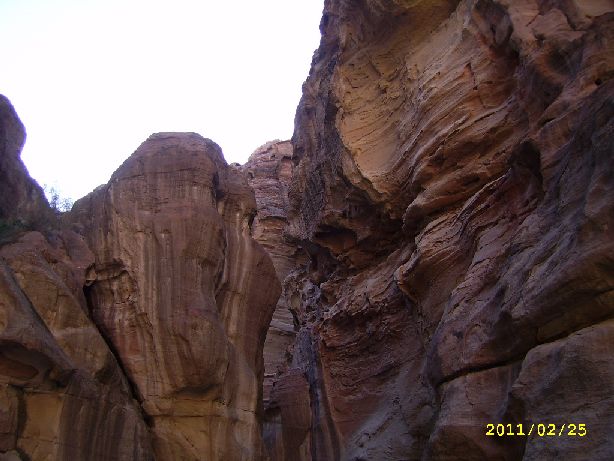
Anyway, after saying so long to Mahmoud, we headed into the Siq, a mile long dry canyon leading to the city, where you see cool stuff like this:


 With the treasury peeking out at the end:


I won't write about Petra, because you can read about it on Wikipedia and then you will know as much as I do. But here are a more pictures. The place is definitely worth a look. Don't go in summer. March was perfect.


After getting our fill of Nabatean ruins for a day and a half, it’s back to the border and Eilat. Now we’re in Eilat, which as a beach resort is a few pegs up on Aqaba, with a slight Las Vegas tinge to it. I think Eilat probably appeals more to the Israeli working stiff or to the Israeli recent immigrant from Russia than it does to the Israeli concert pianist or Israeli systems analyst, but it’s a fun place to rest for a day.


Here you can see the four-country view from our hotel balcony. On the left that’s Jordan and Aqaba. In the haze to the upper right of that derelict-looking freighter that I think was there on my last trip here in 2004 you can sort of make out a bit of Saudi Arabia. And somewhere up in those hills on the right is Egypt. You can see the Egyptian coast better from the beach, but we didn’t bring the camera down there because it’s not good to get it wet. The water just warm enough to splash around for an extended period and just cold enough to wake up with a cold, so it’s with a packet of handkerchiefs in hand that I collect the car keys for the lovely bashed up econo-Hyundai that will be our desert camel for the next few days.

I hadn’t driven a car in several years – there’s not much reason to keep a car in Budapest and I hate driving in Europe anyway, where neither the roads nor the inhabitants are suited to be paired the internal combustion engine, but I kind enjoy driving in Israel, where driving conditions and fellow motorists are more like in North America. Especially crossing the Negev, where there's nobody else to tick you off.


This is the Ramon Crater, a great big crater in the middle of the desert.


And Israel being a small country, by early afternoon we are back at the kibbutz in a completely different climate zone for Sanyi’s birthday. A good time is had by all.

FAQs

Q: At an 80th birthday party on a kibbutz, do they say “Mazeltov” a lot?
A: They say it a lot. So much that I started to think I could understand Hebrew.

Q: What music do they listen to at an 80th birthday party on a kibbutz?
A: Barbra Streisand


The next day we ride the Korean camel up to the Sea of Galilee to meet our friend Anna, who moved to Israeli a few years back and is now living in the Golan with her husband, Robi, and their daughter. Robi is also Hungarian, from the Hungarian-speaking Jewish community in Romania that has pretty much all packed up and left, mainly for Israel.


First we take a quick look around Galilee, home to a bustling tourist industry of buses loading and unloading the faithful from around the world in search of cosmic reverberations of Christianity when it was still at the venture capital stage.

Then Robi and Anna lead us on a tour of the Golan, which is looking very fine and in full bloom this time of year. First stop was Gamla, which was a major site in the Jewish Revolt in 69 AD, but is now a natural park, where they rehabilitate giant vultures.


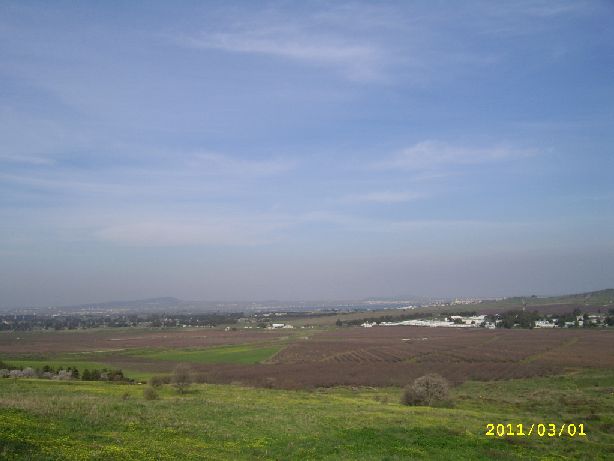
We then had a look up by the Syrian border, which is a partially-militarized area. Golan is an attractive mix of vineyards and geopolitics. Robi, in the car up ahead signals we should pass the Humvee or whatever the hell that thing is. Is it really a good idea to pass an IDF Humvee? Isn’t that like blowing past a police cruiser? But we escaped. That Humvee was just too big and clunky too catch up with our sprightly little Hyundai.


That’s Syria on the other side. Everything looks peaceful. The white encampment houses the UN ceasefire monitoring force, a unit of, currently, Poles who make sure no one moves too many tanks too close to the border and suchlike.


Taken from the same spot but in the other direction is what Robi says, switching into English, “we call a weather station. It tells us whether the Syrians are coming or not.” Golan wine is pretty solid, too.

We finished off the day up by the Lebanese border with some kind of exotic rosehip, honey, and orange-based sweets in a Druze village and a view of Mount Hermon, which at over 2,000 meters allows a local ski industry at 33 degrees of latitude. A country the size of New Jersey and they are skiing on one end and swimming at the beach on the other. This was our last day, so we said goodbye to Anna and Family, drove back to the kibbutz for a nap, and then caught our early morning flight home. Next visit we think we’ll combine it with a visit to Egypt. And who knows, maybe the time after that, some of the other neighbors will be more accommodating to visitors crossing from Israel, and vice versa.