Travel, Central Europe, Budapest Life, Opera, Stuffed Cabbage, Cricket, Silly Rants
Monday, October 17, 2011
Wienerschnitzels just want to be loved
Does this schnitzel look like it was loved? It does not. It looks like the chef found someone much better to while away his Sunday afternoon with. He also seems to have run out of potatoes while the schnitzel was left stewing.
Wienerschnitzels live a difficult life growing only above 15,000 meters in the Tyrolean Alps, and all they want is to be given a warm and affectionate home in somebody's fryer before the Alpine winter sets in and a wild Tafelspitz devours it.
Also, a Hungarian korsó is 500 milliliters, not 400 milliliters, and ever shall remain so. Are you trying to fool me or can your dishwasher not handle regular glasses? And since the barman is slow with the tap, I'll have to order my second beer right when I get the first, won't I? Not good.
6.5 points to Náncsi Néni. Plus points: everybody else's food looked good and it's kind of thrilling to eat under a 100-foot oak raining acorns on the table at pellet gun velocities. Minus points: Feeble feng shui. Requires underground tunnel system so screaming children can transit directly between their parents and the jungle gym fixture in the corner without encroaching on my table area.
Sunday, October 9, 2011
Budapest Walks: Buda Castle, Gellért Hill and Microbrew Festival
Thursday was the last day of our prolonged summer here before a big cold rainy front moved in, hopefully to make way later for an Indian summer, or an old ladies' summer as it's called hereabouts. But to enjoy the last of what we had, we bagged off work for the afternoon to enjoy what may be the last nice weather for a bit.
This is a classic Budapest walk, my favorite circuit to take reasonably ambulatory visitors along on their first day in town, although generally in reverse so that they can take their bearings of the city from the Gellért Hill early on. Also, I can't guarantee we'll have a Microbrew Festival in progress when you come to visit.
From home, the first stretch is alongside the City Park and down elegant Andrássy Avenue. I will write more about these later. at some point. Then we cross the Danube at the landmark Chain Bridge, which is not only hugely symbolic of national unity and achievement, but perhaps more apropros today also a symbol of how hard it is to get privileged people to pay their taxes, since after it was built at significant expense to the national treasury, the nobility invoked their ancient privilege of not paying any tolls, which would have bankrupted the entire project if they had gotten away with it. Today it is a key battlefield in the senseless war between pedestrians and cyclists who come whizzing blindly around the turrets at high speeds. Divisa et impera. The internal combustion engine has triumphed.
And up over the Castle Hill. This particular incarnation of the Buda Castle was built in the late 19th Century (if you don't count rebuilding after WWII) when Hungary was nominally a co-capital of the Empire along with Vienna, and needed a big palace to house the Emperor, in the event he decided to show up, along with other more permanent nabobs. Today it houses the national art museum and performs other worthwhile functions. The twee-ish Castle District, historically the heart of the city, is also worth a look on a differen walk, but but right now we are just shuttling across the hill widthwise and coming down on the rear side of the hill, at the castle's sheer rear side, which I have always admired more than the Danube-facing facade.
And stopped for refreshments at the Arany Szarvas (Golden Stag), which gets special kudos here because the waiter brought a water dish for thirsty Folti without anyone asking.
From there up to the Gellért Hill, which rises more than 100 m from the Danube and provides a nice panorama of the Danube and downtown. Not nearly as high as the Jánosjegy, but since its right in the middle of everything the city appears as an intricate and vast diorama underneath.
After the 1848 Revolution (our uprisings against foreign powers tend to be called "revolutions" rather than "rebellions" on the basis of a complex historical theory of winning-by-losing that may well be unique to Hungary, and whereby we achieve some of our political objectives by getting the crap kicked out of us) the Austrians built this delightful "Citadel" up here in order to have the pesky as yet un-united Budaers and Pesters under heavy artillery fire if they tried any more monkey business. Fast forward 158 years and hapless U.S. President George W. Bush is preparing to give, in the Ukraine, a major address to be broadcast globally justifying his Iraq War as a logical progression in the world's march toward liberty and justice for all in the context of the fall of the Iron Curtain and the end of the Cold War. Except in early 2006 the Ukrainians were busy poisoning their President and the speech had to be moved at the last minute, so Bush invited himself to Budapest and shut down traffic for a week. The only area that could be secured to POTUS standards at short notice was the citadel. So Bush delivered his stirring paean to freedom to a crowd of selected local and international bigwigs - regular people were kept far away, although a couple tramps camped out in the surrounding woods were apparently overlooked by the Secret Service and no doubt had their inner fibre improved via the sound system - in a stone fortress that itself was a symbol of foreign oppression.
And back across the green Freedom Bridge, personally riveted together by HRH Franz Josef himself, first servant of the State, from where we can see the escarpments of the Gellért Hill's palisades.
The Gellért is riddled through with caves formed by hot springs, which themselves feed the baths of the famous nearby Gellért Hotel. Right in the foreground is a culvert that empties the naturally hot water into the river, territory currently under dispute between fishermen who enjoy hooking the fish that gather to munch on the plankton or whatever that blossom in the warmth and vagrants who think it makes a great cut-price spa. I wouldn't suggest either sticking your body in the Danube or eating fish plucked from is depths, but apparently the river's bed is such that both are reasonably safe outside the major cities.
And back through downtown Pest, past alma mater Corvinus U., the Great Market, and Kálvin Square. Where the microbrew festival is just getting underway for the weekend. In general, the making of craft beers is in its infancy in Hungary and they are not that easy to find since the big producers have the market so well dominated, and I would say in Europe in general we don't have the same kind of experimentation with different tastes that you see in the US, although of course the standard for traditional mass-produced beer is higher almost everywhere. So it was a pleasure to taste (all made in Hungary) dark Belgian-style ale, millet beer (probably goes well with the National Cake), Irish red, and some kind of green secret-herb-infused concoction.
On Saturday I returned with Rob and Adrian and tasted a few more: an IPA that taste similar to a Sam Adams or a Harpoon, an honest-to-goodness "Black Lamb" stout, a buckwheat beer (that might have been the star of the show), and real ginger beer.
All in a great setting. I've written before that the 8th district (Josephtown) is the spooky district and reminds me of Philadelphia, but this downtown section has really been fixed up a lot in recent years. So this can be Society Hill. Festival ends today. Visit if you can - we need to support these guys!
This is a classic Budapest walk, my favorite circuit to take reasonably ambulatory visitors along on their first day in town, although generally in reverse so that they can take their bearings of the city from the Gellért Hill early on. Also, I can't guarantee we'll have a Microbrew Festival in progress when you come to visit.
From home, the first stretch is alongside the City Park and down elegant Andrássy Avenue. I will write more about these later. at some point. Then we cross the Danube at the landmark Chain Bridge, which is not only hugely symbolic of national unity and achievement, but perhaps more apropros today also a symbol of how hard it is to get privileged people to pay their taxes, since after it was built at significant expense to the national treasury, the nobility invoked their ancient privilege of not paying any tolls, which would have bankrupted the entire project if they had gotten away with it. Today it is a key battlefield in the senseless war between pedestrians and cyclists who come whizzing blindly around the turrets at high speeds. Divisa et impera. The internal combustion engine has triumphed.
And up over the Castle Hill. This particular incarnation of the Buda Castle was built in the late 19th Century (if you don't count rebuilding after WWII) when Hungary was nominally a co-capital of the Empire along with Vienna, and needed a big palace to house the Emperor, in the event he decided to show up, along with other more permanent nabobs. Today it houses the national art museum and performs other worthwhile functions. The twee-ish Castle District, historically the heart of the city, is also worth a look on a differen walk, but but right now we are just shuttling across the hill widthwise and coming down on the rear side of the hill, at the castle's sheer rear side, which I have always admired more than the Danube-facing facade.
![]() |
| Check out that massive posterior and that shapely plinth! |
From there up to the Gellért Hill, which rises more than 100 m from the Danube and provides a nice panorama of the Danube and downtown. Not nearly as high as the Jánosjegy, but since its right in the middle of everything the city appears as an intricate and vast diorama underneath.
![]() |
| North |
![]() |
| East |
![]() |
| I'm free! |
And back across the green Freedom Bridge, personally riveted together by HRH Franz Josef himself, first servant of the State, from where we can see the escarpments of the Gellért Hill's palisades.
The Gellért is riddled through with caves formed by hot springs, which themselves feed the baths of the famous nearby Gellért Hotel. Right in the foreground is a culvert that empties the naturally hot water into the river, territory currently under dispute between fishermen who enjoy hooking the fish that gather to munch on the plankton or whatever that blossom in the warmth and vagrants who think it makes a great cut-price spa. I wouldn't suggest either sticking your body in the Danube or eating fish plucked from is depths, but apparently the river's bed is such that both are reasonably safe outside the major cities.
And back through downtown Pest, past alma mater Corvinus U., the Great Market, and Kálvin Square. Where the microbrew festival is just getting underway for the weekend. In general, the making of craft beers is in its infancy in Hungary and they are not that easy to find since the big producers have the market so well dominated, and I would say in Europe in general we don't have the same kind of experimentation with different tastes that you see in the US, although of course the standard for traditional mass-produced beer is higher almost everywhere. So it was a pleasure to taste (all made in Hungary) dark Belgian-style ale, millet beer (probably goes well with the National Cake), Irish red, and some kind of green secret-herb-infused concoction.
On Saturday I returned with Rob and Adrian and tasted a few more: an IPA that taste similar to a Sam Adams or a Harpoon, an honest-to-goodness "Black Lamb" stout, a buckwheat beer (that might have been the star of the show), and real ginger beer.
All in a great setting. I've written before that the 8th district (Josephtown) is the spooky district and reminds me of Philadelphia, but this downtown section has really been fixed up a lot in recent years. So this can be Society Hill. Festival ends today. Visit if you can - we need to support these guys!
Saturday, October 1, 2011
Rosenstein
Since I have a blog now, I figure I should incorporate some restaurant reviews and extort free meals out of restaurant owners with my savage keyboard. Please tell all your friends to visit Secrets of the Cabbage and boost my hit count enough pegs to help feed me throughout the ongoing global economic collapse. Also to this end, I would be most grateful if someone would leave convincing comments such as "we visited Rosenstein at your suggestion and you were absolutely bang on about the chauteaubriand. Best 28,000 forints I ever spent!"
Móni's great-uncle Sanyi was visiting from Israel for cousin Szilvi's exuberant wedding last weekend where we all had to dress up as Star Wars characters, and in honor of Rosh Hashanah very kindly invited us out to Rosenstein, an upscale but un-frou-frou place in the 8th district (a dark and spookily atmospheric section of Budapest that reminds me of certain parts of Philadelphia. It might also, like Philadelphia, be a giant portal to the spirit world) that serves out homey non-kosher Jewish-Hungarian classics, some of which have made the crossover into the mainstream Magyar kitchen in various forms, and other Hungarian favorites with TLC and a creative twist.
The thing is we don't eat out so much in Budapest, especially when it comes to Hungarian food, unless we have visitors in town. The reasons for this are 1) with enough time we can usually cook it better and cheaper at home 2) if we do eat out, it's more likely for exotic fare we can't make ourselves such as sushi or pizza or Balkan grills or suchlike 3) we travel a lot both in Hungary and abroad, so restaurant budgets are saved for such excursions, and 4) the troposphere of the Budapest restaurant scene is kind of sketchy: often overpriced and pretentious, and with so many one-off addlepated tourists wandering the inner districts ready to pay big money for someone to glop something with paprika and sour cream into their soup bowls, you have to know where you're going to assure even a regular supper with uncut corners.
Rosenstein is a member of this short list of go-to places to take visitors to: it's a family restaurant, with the father heading up the kitchen, son doing the managing: more than a few notches above the regular standard fare vendéglő but without losing sight of the mitteleuropäische Gemütlichkeit and earnest attention to happiness that warms the spirit. So there's an air of nostalgia, but a crisp air, not a cloying one in a town that can knock you over with cloying nostalgia when it wants to.
This week, because of Rosh Hashanah, the menu is more Jewish than usual. It starts with the traditional apple-honey concoction to assure the sweetness of Year 5772. Then a mixed shared starter plate of Jewish egg (fancy egg salad), goose liver and goose cracklings. Observant Jews in Hungary traditionally ate a lot of geese as their go-to special-occasion meat, whereas Christians would more typically eat pork, and although relatively few of the former keep kosher today, as a country we still serve up plenty of goose for everybody. Hungary today produces a good portion of the world's goose liver (I'm more or less of the view that it doesn't really constitute animal cruelty if done propertly by gentle loving peasant hands, ah, maybe) and it's a good bit cheaper here than France. If you buy canned French foie gras chances are it was produced here and the French added just enough Gallic magic (such as the can) to in good faith stamp "Produit de France" on it and double the price.
For mains, every ordered something different from the expansive menu. Irénke, Móni's 93-year-old grandmother got this giant Jackson Pollack / Piet Mondrian construction of cutlets and potatoes which she dug into with a healthy appetite, with leftovers for the next day.
I was the only one to order off the weekly holiday specials and went with the Sólet (Cholent), a bean casserole, originally Polish and prepared in different ways around the region, and traditionally prepared for the Sabbath (hearty fare that you could nosh on all day without lighting any forbidden flames). This was one of Grandma Irénke's signature dishes before she retired from the kitchen, and I assumed it would be made with smoked goose like hers, so I was surprised to see this mix of ham, sausage and beef brisket-type-thing on top, which is more the way you get it in plain old gentile restaurants and lunch counters, where the good folk may eat it not even knowing of its Jewish origins. Irénke's recipe, which the next generations of the family have also mastered to an adequate level, is also drier, without the tomato and partially-pureed bean paste that forms the base here. They also could have added a bit more of the beans, which were delicious and, last time I checked, not a particularly budget-busting ingredient to serve. In fact, I would have happily sacrificed that bit of knuckle for another spoonful. Anyway, all very fine, but in retrospect if I had vacillated the other way over the sólet versus the stuffed goose neck, I probably would have gotten a more interesting entrée, and one that is kind of a pain to make at home whereas sólet is fairly straightforward. Oh well.
And with most of us having room for dessert, Móni got this flaming crêpe, which for some reason the camera does not agree was actually on fire at the moment of capture, which it was. I think this has something to do with the laws of physics.
And I got this plate of dismembered honey-crêpes covered with poppyseeds.
Oh, I'm supposed to complain about stuff. We hit some kind of kitchen bottleneck and the last main arrived about ten minutes after the first. This can happen, and the waiter apologized profusely, so it's almost a shame to mention it, but that's my job, isn't it? Also guys, need to get that keg of expensive German beer sorted. A gentleman can't be expected to pour from those dainty 12 ounce bottles. This is the whole reason I left the United States.
In addition, they have a really good keyboardist whose talent was wasted on the international faux-classy schlock arrangements of Yesterday, My Way, Time to Say Goodbye, while Liszt's 2nd Hungarian Rhapsody seemed out of place, but he came into its own with the impro jazz that he finished the evening with, which is where his heart seemed to be. Maybe he should start with that too.
And back in the credit colum: we have at Rosenstein the clearly marked (on both menu and website) notice that 10% extra will be added to the total bill for service. Yes. This is the way of the future and we need to support it. It doesn't need to be 10%, it can be whatever your culture has settled on as an adequate percentage, but I hate tipping and tips. Just tell us the price and we'll pay it. The reward for good service is, maybe we'll come back.
On Arthur's Restaurant Scale based on an algorithm so complex, even I don't understand it, Rosenstein gets an 8.
Móni's great-uncle Sanyi was visiting from Israel for cousin Szilvi's exuberant wedding last weekend where we all had to dress up as Star Wars characters, and in honor of Rosh Hashanah very kindly invited us out to Rosenstein, an upscale but un-frou-frou place in the 8th district (a dark and spookily atmospheric section of Budapest that reminds me of certain parts of Philadelphia. It might also, like Philadelphia, be a giant portal to the spirit world) that serves out homey non-kosher Jewish-Hungarian classics, some of which have made the crossover into the mainstream Magyar kitchen in various forms, and other Hungarian favorites with TLC and a creative twist.
The thing is we don't eat out so much in Budapest, especially when it comes to Hungarian food, unless we have visitors in town. The reasons for this are 1) with enough time we can usually cook it better and cheaper at home 2) if we do eat out, it's more likely for exotic fare we can't make ourselves such as sushi or pizza or Balkan grills or suchlike 3) we travel a lot both in Hungary and abroad, so restaurant budgets are saved for such excursions, and 4) the troposphere of the Budapest restaurant scene is kind of sketchy: often overpriced and pretentious, and with so many one-off addlepated tourists wandering the inner districts ready to pay big money for someone to glop something with paprika and sour cream into their soup bowls, you have to know where you're going to assure even a regular supper with uncut corners.
Rosenstein is a member of this short list of go-to places to take visitors to: it's a family restaurant, with the father heading up the kitchen, son doing the managing: more than a few notches above the regular standard fare vendéglő but without losing sight of the mitteleuropäische Gemütlichkeit and earnest attention to happiness that warms the spirit. So there's an air of nostalgia, but a crisp air, not a cloying one in a town that can knock you over with cloying nostalgia when it wants to.
This week, because of Rosh Hashanah, the menu is more Jewish than usual. It starts with the traditional apple-honey concoction to assure the sweetness of Year 5772. Then a mixed shared starter plate of Jewish egg (fancy egg salad), goose liver and goose cracklings. Observant Jews in Hungary traditionally ate a lot of geese as their go-to special-occasion meat, whereas Christians would more typically eat pork, and although relatively few of the former keep kosher today, as a country we still serve up plenty of goose for everybody. Hungary today produces a good portion of the world's goose liver (I'm more or less of the view that it doesn't really constitute animal cruelty if done propertly by gentle loving peasant hands, ah, maybe) and it's a good bit cheaper here than France. If you buy canned French foie gras chances are it was produced here and the French added just enough Gallic magic (such as the can) to in good faith stamp "Produit de France" on it and double the price.
For mains, every ordered something different from the expansive menu. Irénke, Móni's 93-year-old grandmother got this giant Jackson Pollack / Piet Mondrian construction of cutlets and potatoes which she dug into with a healthy appetite, with leftovers for the next day.
![]() |
| Sólet |
![]() |
| Retired Sólet chef extraordinaire |
And with most of us having room for dessert, Móni got this flaming crêpe, which for some reason the camera does not agree was actually on fire at the moment of capture, which it was. I think this has something to do with the laws of physics.
![]() |
| Hope I don't have to take any drug tests |
Oh, I'm supposed to complain about stuff. We hit some kind of kitchen bottleneck and the last main arrived about ten minutes after the first. This can happen, and the waiter apologized profusely, so it's almost a shame to mention it, but that's my job, isn't it? Also guys, need to get that keg of expensive German beer sorted. A gentleman can't be expected to pour from those dainty 12 ounce bottles. This is the whole reason I left the United States.
In addition, they have a really good keyboardist whose talent was wasted on the international faux-classy schlock arrangements of Yesterday, My Way, Time to Say Goodbye, while Liszt's 2nd Hungarian Rhapsody seemed out of place, but he came into its own with the impro jazz that he finished the evening with, which is where his heart seemed to be. Maybe he should start with that too.
And back in the credit colum: we have at Rosenstein the clearly marked (on both menu and website) notice that 10% extra will be added to the total bill for service. Yes. This is the way of the future and we need to support it. It doesn't need to be 10%, it can be whatever your culture has settled on as an adequate percentage, but I hate tipping and tips. Just tell us the price and we'll pay it. The reward for good service is, maybe we'll come back.
On Arthur's Restaurant Scale based on an algorithm so complex, even I don't understand it, Rosenstein gets an 8.
Monday, September 26, 2011
Budapest Beer Bike and Kert Tour
Usually I don't make a big fuss out of my birthday, but you only turn 40 once, and even then only with a bit of luck, so I figured why not see if I could extract some free beers out of my local nearest and dearest. But no sooner did I send out my email to meet up at one of the kerts, that is, one of the beer gardens installed in various courtyards and parks around Budapest during the warmer months, than Móni took over planning, and I was completely in the dark what would be my fate.
The evening started normally enough as designated decoy Adrian led me around the inner 7th district for an hour or two, and finally to a sizeable group of people at Dürer Kert, a couple blocks away from home. Albrecht Dürer is actually of Hungarian origin, name germanized from the Hungarian Ajtósi which also means a guy who makes doors. Except this is not common knowledge so they name his street Ajtósi-Dürer Street just to make it absolutely clear, and here we are hoisting aged cherry pálinka in his kert. Albrecht wasn't around though.
Then a gate was opened and I was led to a strange contraption that proved to be the beer bike we had seen a few times being pedalled around town by joyous revellers and now we too would share their merriment for the next two hours. Blasting pop music (no one though to bring my highlights from the Ring of the Nibelungen CD, which is probably just as well) we made our way down Dózsa György and then Andrássy Avenue, which is roughly the equivalent of riding such a device down Pennsylvania Avenue or Broadway, as far as the Oktogon. Interestingly, no one honked their horns at us and most people smiled and waved as they pulled around us, which seems unusual for grumpy Budapest drivers in immediately post-rush-hour traffic.
As the sweaty birthday boy, I got excused from pedalling after a while, and instead served up the delightful beer bike craft beer to my thirsty beasts of burden. Then after a break for a restorative pleszkavica (they call it a Balkan Burger) at Kertem in the City Park, I got to pop the handbrake and put terrified expressions on the faces of my co-travellers as we veered and swerved through the stygian twisty lanes. Totally cool!
With the beer bike safely back in its garage, we took the much less exotic no. 74 trolley to the Mika Tivadar Kert, where waiting were another host of friends who were either too cool or not cool enough for the beer bike. And I got a Sachertorte and a whole bunch of neat-o presents and cards.
Thanks everyone! Now I'm thinking I should celebrate my birthday annually, or maybe even more frequently!
The evening started normally enough as designated decoy Adrian led me around the inner 7th district for an hour or two, and finally to a sizeable group of people at Dürer Kert, a couple blocks away from home. Albrecht Dürer is actually of Hungarian origin, name germanized from the Hungarian Ajtósi which also means a guy who makes doors. Except this is not common knowledge so they name his street Ajtósi-Dürer Street just to make it absolutely clear, and here we are hoisting aged cherry pálinka in his kert. Albrecht wasn't around though.
Then a gate was opened and I was led to a strange contraption that proved to be the beer bike we had seen a few times being pedalled around town by joyous revellers and now we too would share their merriment for the next two hours. Blasting pop music (no one though to bring my highlights from the Ring of the Nibelungen CD, which is probably just as well) we made our way down Dózsa György and then Andrássy Avenue, which is roughly the equivalent of riding such a device down Pennsylvania Avenue or Broadway, as far as the Oktogon. Interestingly, no one honked their horns at us and most people smiled and waved as they pulled around us, which seems unusual for grumpy Budapest drivers in immediately post-rush-hour traffic.
As the sweaty birthday boy, I got excused from pedalling after a while, and instead served up the delightful beer bike craft beer to my thirsty beasts of burden. Then after a break for a restorative pleszkavica (they call it a Balkan Burger) at Kertem in the City Park, I got to pop the handbrake and put terrified expressions on the faces of my co-travellers as we veered and swerved through the stygian twisty lanes. Totally cool!
With the beer bike safely back in its garage, we took the much less exotic no. 74 trolley to the Mika Tivadar Kert, where waiting were another host of friends who were either too cool or not cool enough for the beer bike. And I got a Sachertorte and a whole bunch of neat-o presents and cards.
Thanks everyone! Now I'm thinking I should celebrate my birthday annually, or maybe even more frequently!
Friday, September 23, 2011
Szekszárd Harvest Festival
September and October are my favorite times of the year and we've been having really lovely weather for the last few weeks, so loads of weekend excursions to write about before the cold and wind come and blow it all away around mid-November, when this blog will go into gloomy winter rumination mode, and probably develop a deep fascination with various fatty pork products, with or without sour cream and cabbage.
But for now, sunny days are here and none is more sunnily spent than a Saturday at the Szekszárd Harvest Festival, about 2 hours south of Budapest. I figured out a few years ago that Szekszárd was putting out some of the best reds in Hungary at a respectable price, a view shared by numerous experts, but for some reason it is the only one of Hungary's half-dozen or so world-class wine regions that I had not visited yet. So, when my local wine merchants at the Borkápolna (Wine Chapel) kindly informed me that they would be sending a bus down for the festival this weekend, I signed us right up.
I'll write more about the Borkápolna in some later post. It really is a chapel. For wine. Great guys. I've been to a few tasting there over the years, but hadn't gone on any of these tours they run to different wine regions. For Botond and Jani, the trip also doubled as a chance to survey the new wines on a commercial basis, so we would get the benefit of their discernment as well.
Hungary makes a lot of wine. Most, of course, is plonk for simple souls, including some really topnotch plonk that this simple soul can't tell apart from real wine, but an increasing portion is made to global standards. Hungarian wine used to be on a par with wine anywhere else, but for 40 years the Communists were sloshing it all into one big barrel and exporting much it off by the tanker load to sun-starved Comintern captive trading partners, whereas the rest of the wine world was at the same time developing new technologies, expertise, and of course tastes, not to mention a clutch of new competitors. So, after 1989 when Hungarian winemaking was both unshackled and tossed to the mercy of the marketplace, there was a certain amount of catch-up to be done. And I think this is part of the attraction, as it is one of the areas of Hungarian life where we can unambiguously see progress being made (despite a couple of rainy summers and poor harvests lately) in a sector composed (albeit not exclusively) of Hungarian producers and not the foreign-owned multis or somesuch, and these winemakers can be mini celebrities in this wine world. The wine regions also attract a good deal of domestic (and some international) tourism, so it's also a great way for urban dwellers to feel a connection to the land.
On Saturday morning we showed up at the chapel and dutifully sucked down our glasses of apricot pálinka to ensure a fortuitous journey and boarded the minibus together with Botond and Jani, their partners partners Cecilia and Zsófia and half a dozen other amiable wine freaks. We reached Szekszárd around noon in beautiful September weather, not a cloud in the sky. Setting a 10 pm rendezvous for the return trip, the driver buggered off to go fishing somewhere.
First, we took a stroll around Szekszárd, with its attractive main square, and had some lunch before the crowds showed up. At these festivals you can also find a wide variety of handicrafts and artisanal foods and whatnot. This one also had a beauty contest to establish who is the cutest young lady in Szekszárd that year, and a scarecrow contest. I only saw one scarecrow though, so I assume she was the winner. No crows though, so she must have been good at her job.
Then it was time for the parade, which included several folk dance troupes from all over Hungary and Transylvania along with musical accompaniment (I had never seen a cello in a marching band before), various local school groups folk singing and/or folk dancing, and cowboys from the Great Plain cracking their whips menacingly (I've tried it, whip cracking is tiring work!).
Now it's time for the wine. There were about 30 local producers set up. Here are Botond and Jani at the Bősz Adrián tent, which wine guru Rob also suggested we visit. Botond is the biggest guy I know in Hungary. He likes to call me "Tiny". We started with a few token whites, mainly whites made from red grapes, for example a white kadarka (Hungaricum), then moved on to the reds that this area is famous for.
The great thing about these festivals is that the prices are set in decilitres, but winemakers are happy to pour half-decileters or smaller quantities, so it's possible to try a lot of different wines without undue adverse effect.
These are the Szekszárd area producers I like the best:
Larger established producers, probably can find them outside of Hungary:
Bodri, Vesztergombi (particularly his Turul cuvée), Tűzkő (in English)
And smaller up-and-coming producers that are probably even hard to find here, but have some exceptional wines at a decent price:
Bősz Adrián, Posta (particularly his Cabernet Franc), Hetényi (particular his Syrah)
At 10 pm just as the party was getting going (and it was really going) it was time to find our bus for the trip home. And then I had to work until all day until midnight on Sunday the next day, in case anyone thinks it's the Life of Riley over here. Need to spend more time in Szekszárd and visit some of these wineries.
Wednesday, September 14, 2011
Bánk Bán
There are lots of good reasons to live in Budapest, along with some good reasons not to live in Budapest. For me, weighing heavily on the pro side is the Hungarian State Opera, a 25 minute walk from the flat, which I have been visiting increasingly frequently, and whose long 2011-2012 season has just started.
They are opening the season with runs of Béla Bártok's "Duke Bluebeard's Castle" (in some kind of razzle-dazzle 3D staging that I hope justifies the high ticket prices) and Ferenc Erkel's "Bánk Bán": the two major Hungarian operas that could possibly be considered part of the standard repertoire, if it were not for the difficulties of staging them in Hungarian outside of Hungary, and therefore the Budapest Opera has assumed a sort of custodial role for the safeguarding of both, and produces them each year. There's occasional talk of premiering Bánk Bán in Washington or Los Angeles, but for now you have to go to Budapest to see it, or to Cluj Napoca (a city of 300,000 with two opera houses, one Romanian and one Hungarian), from whence some of tonight's performers had been poached.
As is often the case, I am on my own, as at this point I can only get Moni to come out for lighter operas or ballets, or orchestral performances, and none of my other friends here are particularly interested either, despite occasional plaintive resolutions to lift their debased cultural states out of the mire.
I've gotten pretty good at working out which are the best seats for the prices available, and prices are rising rapidly even though it's still a fraction of the cost of visiting a comparable opera house in western europe, or the Met. Unless there's something that I want to get a particularly good view of, I usually sit in the "maid's quarters" among the rafters in the top tier, where you can get tickets for as little as 2-6 euros, albeit some with blocked views. The only problem is that these also tend to get snapped up by dilletantes, foreign tourists, and student groups who either don't know how to behave in an opera house or are oblivious thereto and spend most of the time chatting, and the acoustics are so good you can hear even conscientiously breathy whisperers from several rows away. You can only do so much shushing before your evening is ruined. I figured for Bánk Bán, as a historical Hungarian work, we will be overloaded up there with hordes of teenagers who would rather be pretty much anywhere else, and in close proximity to each other with many matters of great import to discuss, so it's time to plump for a decent seat with the gentry.
Here we go, the second row of second floor box 11 right. One of my favourites. You put down 15 euros for the seat on the left, which was engineered for malnourished 19th century skeletons and bottoms, get there a bit early and spread out on the communal red settee behind it, complete with footstool, on its raised platform, and spread out like an octopus. Nice!
I really need a box of my own though, with a valet.
Now, on to Bánk. Bánk is the guy's name. Bán is his title in Medieval Hungary, something like a Viceroy or a Duke. The Queen is some kind of German, and brought all of her foreign relatives and courtiers to wreak havoc on Hungary while the King is off fighting somewhere. Her brother even makes advances on Bánk's wife Melinda right under his nose, and attacks her, but Bánk thinks he's been betrayed and sends her off to the family estate in the countryside. Beset by grief for his suffering homeland (and himself) - actually this is where we get the single most catchy aria from the opera, "Hazám Hazám" (my homeland, my homeland): seen below sung by Attila B. Kiss, the same performer as last night in a 2007 performance in Szeged. Give it until 1:20 or so to really get going.
Musically, what's interesting is that the narrative of the opera, which was written around 1860, is driven by an Italian style, notably Verdi, I think, whereas for the arias like this one, and dances, he introduces Hungarian folk themes, which I am pretty sure no one had done before, particularly since Bártok and Kodály wouldn't be born for another 20 years.
Anyway, Bánk confronts the Queen to mend her evil ways and winds up killing her after she pulls a knife on him. Melinda, now insane, drowns herself and their son, the revelation of which by dragging their bodies into the court seems to get Bánk off the hook from being sliced apart by the king's sword as the curtain falls on a permeating sense of general tragedy.
It's actually kind of a political opera even today. Substitute a bunch of foreign banks for the courtiers. The EU for the Queen, Audis for horses, etc., and you have a Fidesz parable for the country's current parlous state. Actually, I think there were some government ministers in attendance as I noticed a police presence outside on the way in, and some kind of closed function being guarded by goons during the intermission. I am pretty sure not too many ministers go to see "Rigoletto".
Musically, this guy Kiss was right on as Bánk. Melinda, the other main role, was played by Ibolya Vigh a young soprano from Cluj. In the first act as the vivacious Melinda she sounded a bit tight in the high registers, but as her role gets darker and the notes (mainly) lower, she brought a really haunting quality to it, especially to her final scene before throwing herself into the waves. Expect more from her.
They are opening the season with runs of Béla Bártok's "Duke Bluebeard's Castle" (in some kind of razzle-dazzle 3D staging that I hope justifies the high ticket prices) and Ferenc Erkel's "Bánk Bán": the two major Hungarian operas that could possibly be considered part of the standard repertoire, if it were not for the difficulties of staging them in Hungarian outside of Hungary, and therefore the Budapest Opera has assumed a sort of custodial role for the safeguarding of both, and produces them each year. There's occasional talk of premiering Bánk Bán in Washington or Los Angeles, but for now you have to go to Budapest to see it, or to Cluj Napoca (a city of 300,000 with two opera houses, one Romanian and one Hungarian), from whence some of tonight's performers had been poached.
As is often the case, I am on my own, as at this point I can only get Moni to come out for lighter operas or ballets, or orchestral performances, and none of my other friends here are particularly interested either, despite occasional plaintive resolutions to lift their debased cultural states out of the mire.
I've gotten pretty good at working out which are the best seats for the prices available, and prices are rising rapidly even though it's still a fraction of the cost of visiting a comparable opera house in western europe, or the Met. Unless there's something that I want to get a particularly good view of, I usually sit in the "maid's quarters" among the rafters in the top tier, where you can get tickets for as little as 2-6 euros, albeit some with blocked views. The only problem is that these also tend to get snapped up by dilletantes, foreign tourists, and student groups who either don't know how to behave in an opera house or are oblivious thereto and spend most of the time chatting, and the acoustics are so good you can hear even conscientiously breathy whisperers from several rows away. You can only do so much shushing before your evening is ruined. I figured for Bánk Bán, as a historical Hungarian work, we will be overloaded up there with hordes of teenagers who would rather be pretty much anywhere else, and in close proximity to each other with many matters of great import to discuss, so it's time to plump for a decent seat with the gentry.
Here we go, the second row of second floor box 11 right. One of my favourites. You put down 15 euros for the seat on the left, which was engineered for malnourished 19th century skeletons and bottoms, get there a bit early and spread out on the communal red settee behind it, complete with footstool, on its raised platform, and spread out like an octopus. Nice!
I really need a box of my own though, with a valet.
Now, on to Bánk. Bánk is the guy's name. Bán is his title in Medieval Hungary, something like a Viceroy or a Duke. The Queen is some kind of German, and brought all of her foreign relatives and courtiers to wreak havoc on Hungary while the King is off fighting somewhere. Her brother even makes advances on Bánk's wife Melinda right under his nose, and attacks her, but Bánk thinks he's been betrayed and sends her off to the family estate in the countryside. Beset by grief for his suffering homeland (and himself) - actually this is where we get the single most catchy aria from the opera, "Hazám Hazám" (my homeland, my homeland): seen below sung by Attila B. Kiss, the same performer as last night in a 2007 performance in Szeged. Give it until 1:20 or so to really get going.
Musically, what's interesting is that the narrative of the opera, which was written around 1860, is driven by an Italian style, notably Verdi, I think, whereas for the arias like this one, and dances, he introduces Hungarian folk themes, which I am pretty sure no one had done before, particularly since Bártok and Kodály wouldn't be born for another 20 years.
Anyway, Bánk confronts the Queen to mend her evil ways and winds up killing her after she pulls a knife on him. Melinda, now insane, drowns herself and their son, the revelation of which by dragging their bodies into the court seems to get Bánk off the hook from being sliced apart by the king's sword as the curtain falls on a permeating sense of general tragedy.
It's actually kind of a political opera even today. Substitute a bunch of foreign banks for the courtiers. The EU for the Queen, Audis for horses, etc., and you have a Fidesz parable for the country's current parlous state. Actually, I think there were some government ministers in attendance as I noticed a police presence outside on the way in, and some kind of closed function being guarded by goons during the intermission. I am pretty sure not too many ministers go to see "Rigoletto".
Musically, this guy Kiss was right on as Bánk. Melinda, the other main role, was played by Ibolya Vigh a young soprano from Cluj. In the first act as the vivacious Melinda she sounded a bit tight in the high registers, but as her role gets darker and the notes (mainly) lower, she brought a really haunting quality to it, especially to her final scene before throwing herself into the waves. Expect more from her.
Tuesday, September 13, 2011
Dalmatian Holiday
Not one but two trips south of the border to Yugoslavia this year! (Yes, I know Yugoslavia doesn’t exist any longer, but please humor me) In this case it is the Dalmatian coast, to bake in the sun and eat nothing but grilled squid and cevapcici, and maybe a little bit of prsut (Dalmatian prosciutto minus the vowels) on my toast for breakfast.
Móni and I had been to Croatia on numerous occasions, all up and down the Dalmatian coast. It’s our closest stretch of seashore, so is a kind of a default beach holiday for Hungarians who need a salt-water fix they can’t find on Lake Balaton. Lots of interesting stuff to see, although we wouldn’t be covering much of any new ground on this trip. Basically, the further south you go on the coast, the more dramatic the scenery, and the less crowded the beaches, so for this trip we had picked out a spot on the Peljesac peninsula between Split and Dubrovnik, a long mountainous knob sticking out of the sea, yearning to be an island but not quite succeeding, and studded with little fishing villages and vineyards – we were in the tiny village of Postup, the second most famous wine producing area in all of Croatia.
This was a sort of mix-and-match family holiday for us (with Móni’s sister Andi and her partner Péter, and Péter’s parents, and my Mother and husband Gil, who fly to Europe regularly to visit her family and fit in a trip with us to some part of Europe they hadn’t seen before. And, of course, Folti, who temporarily mutates into an otter whenever we visit the seacoast, or any body of water short of a puddle, in which she mutates into a miniature furry hippopotamus) renting an apartment for a week and taking daytrips some of the time and enjoying the sun and sea for the rest, which the proper way to enjoy a Mediterranean holiday. Wherever you go, there is always something interesting to see nearby.
I can tell you it took a lot of work to find some kind of combination of 4 bedrooms, four bathrooms in a beach residence that takes dogs and that everyone could agree on. Nothing fancy, and a bit far from both civilization and the beach, but with a marvelous view of Korcula and the Adriatic.
We reach it after a two-day drive—having stopped over in Trogir in middle Dalmatia, a lovely little town close to Split, where we picked up Mom and Gil, who had flown down from Budapest. Trogir was where we stayed for the week on our first visit to Croatia, and I recommend it for a quick airborne visit from points north and west, since Split airport is right next door, especially if you are a plane spotting aficionado.
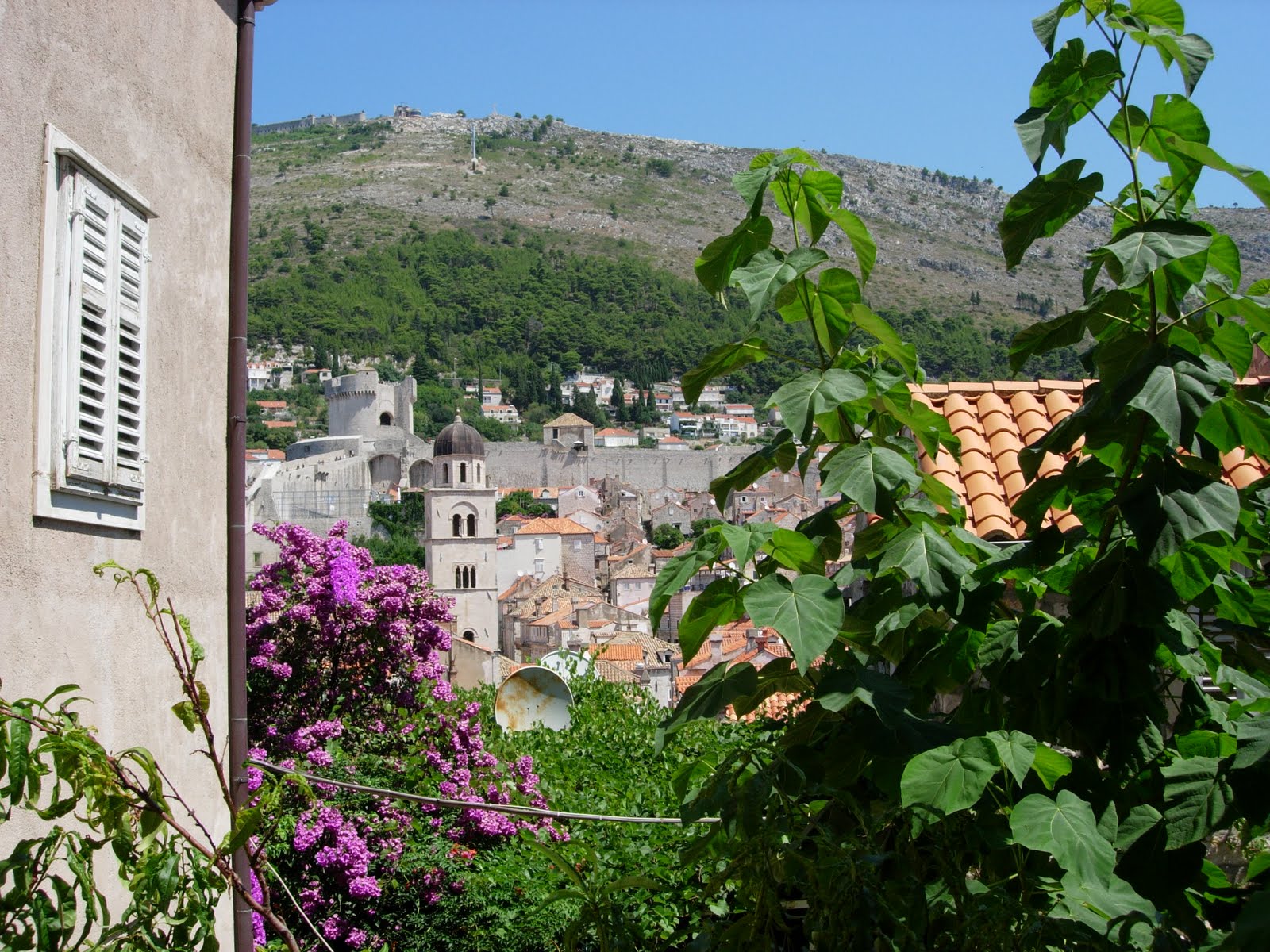
After finding our apartment and resting our drivers for the first day, we took our first excursion to Dubrovnik on the second day: a well-preserved little gem of a former city state that flourished on maritime trade for several centuries by outwitting its much stronger enemies, like the Turks and Venetians, until Napoleon came around and ended the party. It took a beating in the Yugoslav wars but was already restored by my first visit, in 2002 or so. Now there are loads and loads of tourists, and of course, mediocre overpriced cooking to feed them.
Second day trip is to Korcula town and a tour around lovely Korcula island, across the sound by Ferry from Postup. This was once a fairly important port, as far back as medieval times, and claims Marco Polo as one of its sons. These cities on the coast have always been closely linked to Italy, and particularly to Venice, although not on an entirely friendly basis, and one enters into the debate about whether he was a Dalmatia Italian or a Dalmatian Croat, or even a Dalmatian at all, at one’s own peril. Great grilled fish in the little fishing villages outside of Korcula town itself.
The third day trip is to Mostar, in Bosnia. Well, technically, Herzegovina. The Stari Most, now the Novi Stari Most, since after surviving 500 years of Balkan history, the Croat artillery saw fit to shell the original, along with the rest of the downtown area, for no good strategic reason except to remove physical cultural evidence of the Islamic presence in the region. There’s a new Muslim cemetery next to one of the downtown mosques where every single headstone I saw, for infants, children, adults, and geriatrics, all bore 1993 as the year of death.
But the city seems to be recovering nicely now, at least from an outsider's point of view. Mostar still looked pretty much like a war zone at our last visit in 2005, which formed an interesting counterpart to the flowering banks of the Neretva and the rebuilt bridge rising above them. Today, almost all of the major buildings in the bustling downtown area seem to be rebuilt, although a lot of the walls still show shell/bullet damage – which we still have in Budapest too in many spots, left over from WWII and 1956.
You don’t usually get too much colorful interaction with the locals on these beach holidays in high season, especially with a big family group, but there was a funny one here with a jovial Bosnian border guard who, spying the “H” on Peter’s license plate, initiated a conversation with Peter which consisted entirely of their reciting the names of Hungarian and Serbian water polo players, pointing and laughing. And then: “London!” “London! Da! Da! Ahahahhaa!” Point. Waggle finger. "Ahahahahha"
The less jovial Bosnian police are notoriously concerned about making sure tourists do not risk and limb by taking the unfamiliar roadways at the same speeds that the locals do, or even giving the appearance, to them, of doing so, despite what your odometers say. Peter’s father, driving the other car met them this time, although we knew from experience to crawl along and enjoy the (very striking) scenery along the Netetva. Fortunately, fines can be negotiated to meet any budget, as long as you don’t expect a written record. Don’t get angry; just think of it as a tourist tax.
The rest of the week was given over to resting on the beach, but not for Arthur. In 2005 when we were here in the area, I swore that one day I would conquer Sveti Ilija (Saint Elijah), the 961m peak looming atop the peninsula, and now the hour of our reckoning had struck.
After some initial interest from among my various co-travelers collapsed, it was by myself that I set out from the Franciscan monastery in Orebic. Excelsior! It’s not really a good idea to climb such mountains solo, particularly in the light drizzle that was falling, so I hung around to make sure others were also making the climb, and partially glommed on to a couple Poles with whom I could compare notes in pidgin German as to where the cross marking our final destination might stand: “Hier giebts es kein Kreuz!”, “Vielleicht da drüben!”, “ja! noch ein bisschen”.
Made it in 2 hours and 45 minutes. From the peak you get a great view of most of Europe and parts of northern Africa, and Asia Minor. Back down in about 2, which exactly corresponded to the lifespan of the Chinese children’s knockoff Juventus FC knapsack I had picked up in Mostar the previous day for 5 euro for the purpose of slogging my water bottles up this hill.
On the final day, able to hobble no further than the distance between the kitchen and the backyard grill (the old fashioned kind with a chimney) I appointed myself grillmaster and fired up a bunch of squid and cevapcici – exactly what we had been eating all week for three times the price at restaurants all over the area.
Croatians make the best grilled calamari. Everyone else wants to bread it like some kind of crazy onion ring, which completely kills the flavor, you might as well just eat onions, but the Croats know that it should be grilled whole until only slightly chewy (a tip—tentacles don’t grill well. You can throw the tentacles in a tomato sauce for pasta instead). The squid were all frozen imported from South America, so I don’t know why we can’t do this in Hungary. One gets conflicting information about how much fish and squid is actually left in the Adriatic these days. Based on my look at fish markets and supermarkets both here and on the Italian side last year, I would guess not so much as one would like.
In many ways, for me, Croatian is the ultimate national cuisine because due its odd shape and history, half of the country is really, historically and climate-wise, part of Central Europe and they eat stuff that is similar to the tastier things that Hungarians eat, whereas on the coast the Italian influence provides them with excellent pastas and risottos, including seafood for as long as stocks hold out, and the Balkan influence means they have excellent seasoned grilled meats and burek and whatnot. So if some hypothetical culinary bully came along with a baseball bat and informed me I could only eat food from one country for the rest of my life, but could pick which one, I might pick Croatian as kind of a cop out.
The local red wine turns out very well too, even though I didn’t taste too much as it was August with heavy-duty walking involved, so I was more interested in the juice of the barley when it came time to rehydrate, but we did try some from the local vintners and they do in fact make some stalwart southern reds out of this plavi mali “little blue” grape of theirs, some a bit raisin-y. Whites were a bit less interesting, but I don’t usually go bananas over Mediterranean whites anyway, except for sherries.
Our week is up. Time to clear out. On the way back we have to deposit Mom and Gil at Split for their flight home, so assuming traffic holds out this will be the day to show them Diocletian’s palace. The traffic does hold out! Generally, apartments in Croatia change over on Saturdays, which means that everybody wants in and out at the same time and on past trips we have had to contend with epic traffic jams, but now that the new highway is in place (and it really is a splendid highway if pricy at the tollgate, with lots tunnels through the Dinaric Alps that look like they were put there by serious Teutonic engineering company) almost the entire way down to Dubrovnik, there were really no problems.
So we had an hour and a half to join the throngs in a quick tour of Split. One thing about a declining birth rate in Europe is at least in a few decades those of us who remain will be able to enjoy our cultural patrimony in peace. In truth though, places like Split and Dubrovnik should be seen at least once in life, so we can’t begrudge our fellow tourists for showing up, only for their idiotic comments. They should read the book first so they know what they are looking at instead of standing in the way gawking. One of these days I would like to visit the Adriatic in the off-season. November or March. Probably not Split though. Trieste and the Slovene coast is next on my list. Border regions! Love them! Also need to make it to Sarajevo sometime.
My copy of “Black Lamb and Grey Falcon” isn’t going to survive too many more trips to the Balkan so I picked up an overpriced copy of Misha Glenny’s “Fall of Yugoslavia” at one of the Split bookstores to see if it changes my mind on anything. So far not: still feel that the Serbs were unfairly singled out, maligned, and air-struck in a complicated situation full of devious politicians where there was plenty of blame to go around.
Last stop – on the way home we slept overnight in bungalows at a campsite near Plitvice National Park (finally a place I hadn’t already seen once or twice!). This is a beautiful assortment of lakes at different levels connected by a somewhat otherworldly network of waterfalls. We only had a few hours to walk around on the platforms they had though, so this area will merit a future visit for a few days of hiking someday, if the bears don’t eat us.
![]() |
| Bosnian grill. Who told them beer should be sweet? |
![]() |
| Cove at Postup |
![]() |
| Folti the otter. Taken from Korcula. Orebic and Postup in background. |
This was a sort of mix-and-match family holiday for us (with Móni’s sister Andi and her partner Péter, and Péter’s parents, and my Mother and husband Gil, who fly to Europe regularly to visit her family and fit in a trip with us to some part of Europe they hadn’t seen before. And, of course, Folti, who temporarily mutates into an otter whenever we visit the seacoast, or any body of water short of a puddle, in which she mutates into a miniature furry hippopotamus) renting an apartment for a week and taking daytrips some of the time and enjoying the sun and sea for the rest, which the proper way to enjoy a Mediterranean holiday. Wherever you go, there is always something interesting to see nearby.
I can tell you it took a lot of work to find some kind of combination of 4 bedrooms, four bathrooms in a beach residence that takes dogs and that everyone could agree on. Nothing fancy, and a bit far from both civilization and the beach, but with a marvelous view of Korcula and the Adriatic.
We reach it after a two-day drive—having stopped over in Trogir in middle Dalmatia, a lovely little town close to Split, where we picked up Mom and Gil, who had flown down from Budapest. Trogir was where we stayed for the week on our first visit to Croatia, and I recommend it for a quick airborne visit from points north and west, since Split airport is right next door, especially if you are a plane spotting aficionado.
After finding our apartment and resting our drivers for the first day, we took our first excursion to Dubrovnik on the second day: a well-preserved little gem of a former city state that flourished on maritime trade for several centuries by outwitting its much stronger enemies, like the Turks and Venetians, until Napoleon came around and ended the party. It took a beating in the Yugoslav wars but was already restored by my first visit, in 2002 or so. Now there are loads and loads of tourists, and of course, mediocre overpriced cooking to feed them.
![]() |
| Main square of Dubrovnik |
![]() |
| Labarynthine alleyways |
![]() |
| But walk out the old city gate and you're at the beach |
![]() |
| No cars. My kind of town. |
![]() |
| Fascinating interplay of light and shadow |
Second day trip is to Korcula town and a tour around lovely Korcula island, across the sound by Ferry from Postup. This was once a fairly important port, as far back as medieval times, and claims Marco Polo as one of its sons. These cities on the coast have always been closely linked to Italy, and particularly to Venice, although not on an entirely friendly basis, and one enters into the debate about whether he was a Dalmatia Italian or a Dalmatian Croat, or even a Dalmatian at all, at one’s own peril. Great grilled fish in the little fishing villages outside of Korcula town itself.
![]() |
| Gazing out yonder from the tower of what might be the Marco Polo family house, depending on whom you ask |
![]() |
| Just like the cover of my copy of Black Lamb and Grey Falcon |
![]() |
| Exotic stuff for a fair price, probably made in China |
![]() |
| Nice restored houses and shovelled house |
![]() |
| Looking up the Neretva from the bridge |
![]() |
| Folti leading Andi and Peter up the bridge |
![]() |
| For a few Euros you can watch these guys risk death. Or even better, wait for someone else to pay and watch for free. |
![]() |
| Where'd he go? |
![]() |
| Mom and Gil in front of Mosque |
![]() |
| Mosque interior. Work of Mimar Sinan - creator of the Istanbul cityscape |
![]() |
| Turkish-style house |
![]() |
| Shell damage. expensive cars. dramatic setting. |
But the city seems to be recovering nicely now, at least from an outsider's point of view. Mostar still looked pretty much like a war zone at our last visit in 2005, which formed an interesting counterpart to the flowering banks of the Neretva and the rebuilt bridge rising above them. Today, almost all of the major buildings in the bustling downtown area seem to be rebuilt, although a lot of the walls still show shell/bullet damage – which we still have in Budapest too in many spots, left over from WWII and 1956.
You don’t usually get too much colorful interaction with the locals on these beach holidays in high season, especially with a big family group, but there was a funny one here with a jovial Bosnian border guard who, spying the “H” on Peter’s license plate, initiated a conversation with Peter which consisted entirely of their reciting the names of Hungarian and Serbian water polo players, pointing and laughing. And then: “London!” “London! Da! Da! Ahahahhaa!” Point. Waggle finger. "Ahahahahha"
The less jovial Bosnian police are notoriously concerned about making sure tourists do not risk and limb by taking the unfamiliar roadways at the same speeds that the locals do, or even giving the appearance, to them, of doing so, despite what your odometers say. Peter’s father, driving the other car met them this time, although we knew from experience to crawl along and enjoy the (very striking) scenery along the Netetva. Fortunately, fines can be negotiated to meet any budget, as long as you don’t expect a written record. Don’t get angry; just think of it as a tourist tax.
The rest of the week was given over to resting on the beach, but not for Arthur. In 2005 when we were here in the area, I swore that one day I would conquer Sveti Ilija (Saint Elijah), the 961m peak looming atop the peninsula, and now the hour of our reckoning had struck.
![]() |
| Szent Ilija from Korcula |
After some initial interest from among my various co-travelers collapsed, it was by myself that I set out from the Franciscan monastery in Orebic. Excelsior! It’s not really a good idea to climb such mountains solo, particularly in the light drizzle that was falling, so I hung around to make sure others were also making the climb, and partially glommed on to a couple Poles with whom I could compare notes in pidgin German as to where the cross marking our final destination might stand: “Hier giebts es kein Kreuz!”, “Vielleicht da drüben!”, “ja! noch ein bisschen”.
![]() |
| Italy, the Gulf of Lyons, and North Africa |
![]() |
| Hier haben wir ein Kreuz. |
Made it in 2 hours and 45 minutes. From the peak you get a great view of most of Europe and parts of northern Africa, and Asia Minor. Back down in about 2, which exactly corresponded to the lifespan of the Chinese children’s knockoff Juventus FC knapsack I had picked up in Mostar the previous day for 5 euro for the purpose of slogging my water bottles up this hill.
On the final day, able to hobble no further than the distance between the kitchen and the backyard grill (the old fashioned kind with a chimney) I appointed myself grillmaster and fired up a bunch of squid and cevapcici – exactly what we had been eating all week for three times the price at restaurants all over the area.
Croatians make the best grilled calamari. Everyone else wants to bread it like some kind of crazy onion ring, which completely kills the flavor, you might as well just eat onions, but the Croats know that it should be grilled whole until only slightly chewy (a tip—tentacles don’t grill well. You can throw the tentacles in a tomato sauce for pasta instead). The squid were all frozen imported from South America, so I don’t know why we can’t do this in Hungary. One gets conflicting information about how much fish and squid is actually left in the Adriatic these days. Based on my look at fish markets and supermarkets both here and on the Italian side last year, I would guess not so much as one would like.
In many ways, for me, Croatian is the ultimate national cuisine because due its odd shape and history, half of the country is really, historically and climate-wise, part of Central Europe and they eat stuff that is similar to the tastier things that Hungarians eat, whereas on the coast the Italian influence provides them with excellent pastas and risottos, including seafood for as long as stocks hold out, and the Balkan influence means they have excellent seasoned grilled meats and burek and whatnot. So if some hypothetical culinary bully came along with a baseball bat and informed me I could only eat food from one country for the rest of my life, but could pick which one, I might pick Croatian as kind of a cop out.
The local red wine turns out very well too, even though I didn’t taste too much as it was August with heavy-duty walking involved, so I was more interested in the juice of the barley when it came time to rehydrate, but we did try some from the local vintners and they do in fact make some stalwart southern reds out of this plavi mali “little blue” grape of theirs, some a bit raisin-y. Whites were a bit less interesting, but I don’t usually go bananas over Mediterranean whites anyway, except for sherries.
Our week is up. Time to clear out. On the way back we have to deposit Mom and Gil at Split for their flight home, so assuming traffic holds out this will be the day to show them Diocletian’s palace. The traffic does hold out! Generally, apartments in Croatia change over on Saturdays, which means that everybody wants in and out at the same time and on past trips we have had to contend with epic traffic jams, but now that the new highway is in place (and it really is a splendid highway if pricy at the tollgate, with lots tunnels through the Dinaric Alps that look like they were put there by serious Teutonic engineering company) almost the entire way down to Dubrovnik, there were really no problems.
So we had an hour and a half to join the throngs in a quick tour of Split. One thing about a declining birth rate in Europe is at least in a few decades those of us who remain will be able to enjoy our cultural patrimony in peace. In truth though, places like Split and Dubrovnik should be seen at least once in life, so we can’t begrudge our fellow tourists for showing up, only for their idiotic comments. They should read the book first so they know what they are looking at instead of standing in the way gawking. One of these days I would like to visit the Adriatic in the off-season. November or March. Probably not Split though. Trieste and the Slovene coast is next on my list. Border regions! Love them! Also need to make it to Sarajevo sometime.
My copy of “Black Lamb and Grey Falcon” isn’t going to survive too many more trips to the Balkan so I picked up an overpriced copy of Misha Glenny’s “Fall of Yugoslavia” at one of the Split bookstores to see if it changes my mind on anything. So far not: still feel that the Serbs were unfairly singled out, maligned, and air-struck in a complicated situation full of devious politicians where there was plenty of blame to go around.
![]() |
| Lots of waterfalls |
Last stop – on the way home we slept overnight in bungalows at a campsite near Plitvice National Park (finally a place I hadn’t already seen once or twice!). This is a beautiful assortment of lakes at different levels connected by a somewhat otherworldly network of waterfalls. We only had a few hours to walk around on the platforms they had though, so this area will merit a future visit for a few days of hiking someday, if the bears don’t eat us.
Subscribe to:
Posts (Atom)